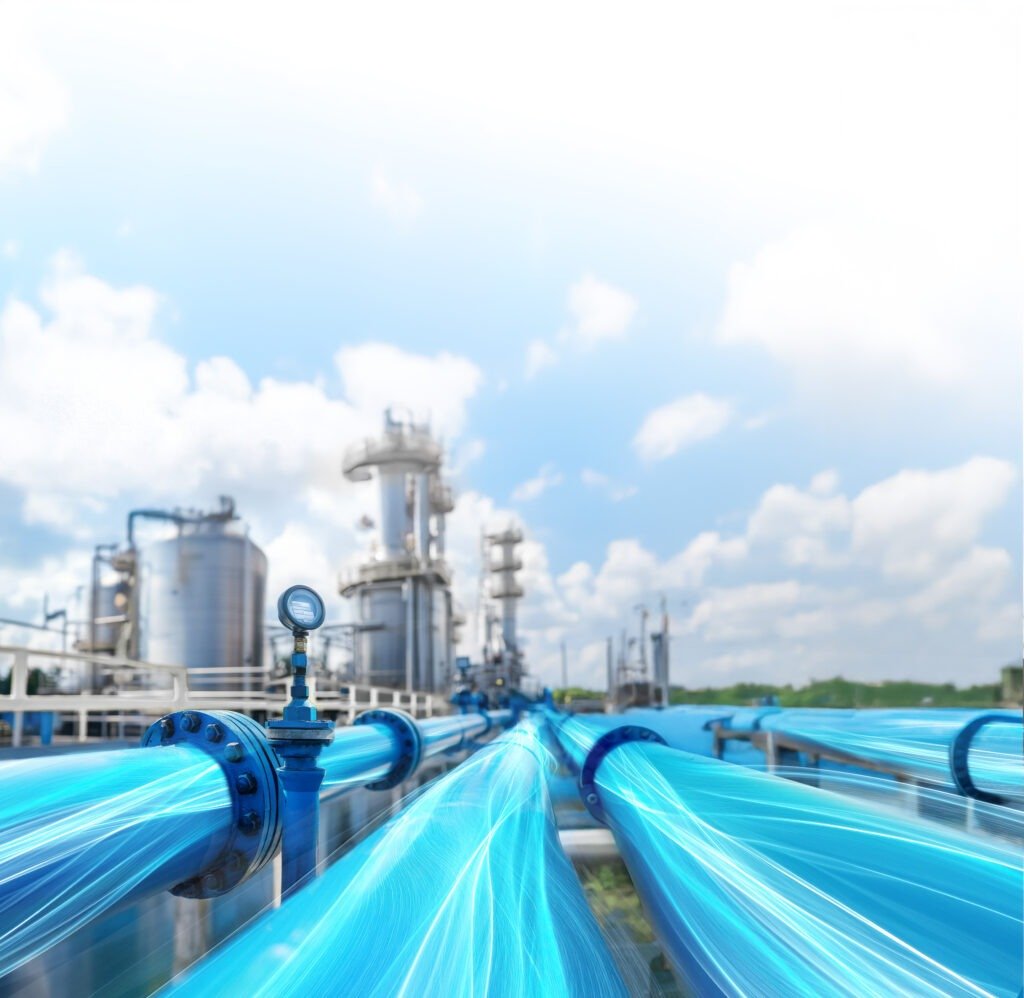
Since 1864, AERZEN has engineered compressed air and gas handling solutions for the most demanding industrial environments on earth. That 160-year heritage includes understanding a fundamental truth: a compressor or blower that cannot start after a weather event is as useful as no machine at all.
Thailand’s eastern seaboard — home to the Eastern Economic Corridor (EEC) and some of the country’s most concentrated industrial capacity — lies within the path of tropical cyclones and seasonal flooding. For Operations Managers responsible for keeping production lines running, compressed air resilience is not a theoretical concern. It is a business continuity obligation.
This article provides a structured framework for building a disaster recovery plan specific to compressed air and blower systems, with reference to internationally recognized standards and first-party engineering perspectives from AERZEN Rental Thailand.
Why Compressed Air Is Your Most Vulnerable Utility
Electricity, cooling water, and natural gas all have well-established emergency protocols. Compressed air and process gas systems — blowers for wastewater aeration, compressors for pneumatic conveying, instrument air for control systems — are frequently overlooked in Business Continuity Planning (BCP).
The consequences of that oversight become visible the moment floodwater enters a compressor room:
- Motor windings absorb moisture, causing insulation resistance to drop below the 1 MΩ minimum required for safe energization (IEC 60034-27-1)
- Bearing housings corrode when left in standing water, seizing rotors within 48-72 hours of exposure depending on bearing preload and lubricant type
- Control panels lose logic, requiring full PLC re-commissioning before the machine can accept start commands
- Inlet filters collapse under sustained water ingress, drawing contaminated air or water directly into compression chambers
A 5,000 m³/h blower serving a wastewater treatment plant does not have the luxury of a three-week repair cycle. Regulatory discharge limits do not pause for floods.
Risk Assessment: Classifying Your Compressed Air Assets
Before designing a resilience plan, classify each compressed air and blower asset by two dimensions: criticality and flood exposure.
Criticality Tiers
| Tier | Definition | Example |
|---|---|---|
| Tier 1 — Mission Critical | Plant cannot operate at all without this machine | Instrument air compressor; wastewater aeration blower |
| Tier 2 — Production Critical | Loss affects one or more production lines | Pneumatic conveying blower; CIP compressed air |
| Tier 3 — Supportive | Loss degrades efficiency but does not stop production | General shop air; cooling air for ancillary equipment |
Flood Exposure Classification
Use topographic elevation data and historical flood extent maps from the Department of Water Resources Thailand (กรมทรัพยากรน้ำ) to classify each installation:
- Zone A: Elevation ≥2 m above 100-year flood line — Low exposure
- Zone B: Elevation 0.5-2 m above 100-year flood line — Medium exposure; requires mitigation
- Zone C: Below or at 100-year flood line — High exposure; requires relocation or hard protection
The 2011 Chao Phraya flood demonstrated that Zone B classifications built on pre-2000 flood data are often inadequate. Operations Managers in the EEC should request updated flood modelling from their local Industrial Estate Authority.
The Four Pillars of Compressed Air Disaster Resilience
Pillar 1 — Elevation and Physical Protection
The most cost-effective resilience measure for Tier 1 assets is physical separation from flood risk.
Recommended minimum elevation for compressor room floor: 0.8 m above the site’s 50-year flood line (or per local industrial estate authority requirement, whichever is higher).
For existing installations at ground level:
- Flood gates (stop logs): Pre-fabricated aluminum or steel barriers seal doorways to 0.5-1.0 m depth within minutes. IEC 60529 IP68-rated control panels can withstand temporary immersion but motor windings remain vulnerable.
- Compact temporary bund systems: Deployable fabric bunds (Tiger Dam or equivalent) create a perimeter around critical equipment within 2-4 hours with a 4-person team.
- Permanent concrete bunds: For Tier 1 assets in Zone B, a 0.8 m reinforced concrete bund with sealed conduit penetrations is the engineered standard.
Pillar 2 — Redundancy and Standby Capacity
A single-machine philosophy for Tier 1 compressed air assets is an unacceptable risk posture for any plant subject to typhoon or flood events.
N+1 redundancy minimum for Tier 1: One standby machine, ideally on an elevated secondary pad or portable skid mount, capable of matching Tier 1 flow and pressure within 30 minutes of activation.
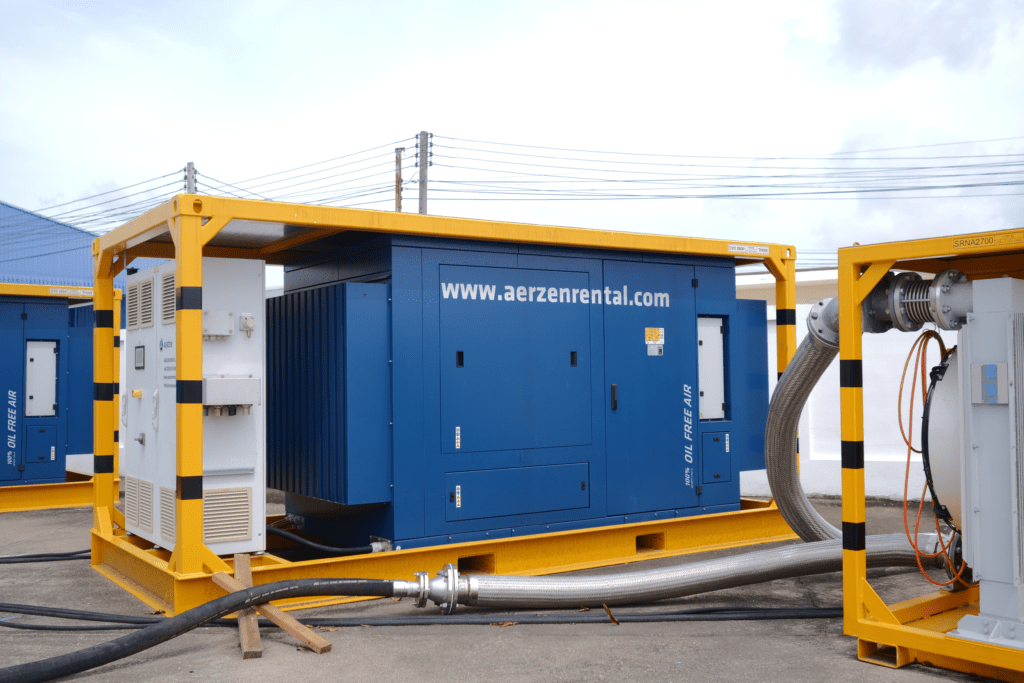
AERZEN rental fleet as standby capacity: Rather than purchasing a permanent standby machine that operates zero hours in most years, Operations Managers increasingly structure a pre-arranged emergency rental agreement with AERZEN Rental Thailand. This provides:
- Confirmed machine availability at agreed lead time (typically 24-48 hours for standard models from AERZEN’s EEC-region fleet)
- Known mobilization cost built into BCP budget
- Elimination of ownership costs for a machine used only in emergencies
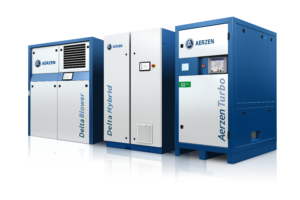
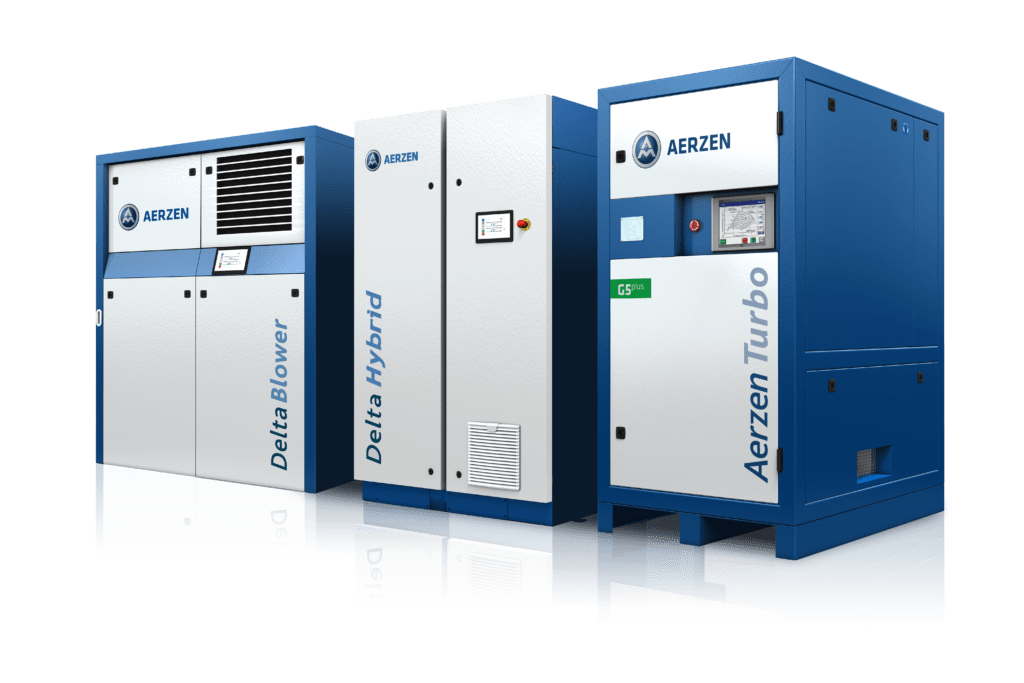
AERZEN’s rental fleet includes BVS Rotary Lobe Roots Blowers, DVO Delta Hybrid Screw Blowers, and BVO Delta Screw Blowers across a range of flow rates and pressures suitable for most Tier 1 applications in wastewater, food and beverage, and electronics sectors.
Pillar 3 — Rapid Restart Protocol
Even if a compressor survives a flood event physically intact, energizing it without a restart protocol risks motor burnout, bearing failure, or control system damage.
Post-flood inspection checklist before restart:
- Insulation resistance test (IR test): Measure motor winding IR with a 500V megohmmeter. Minimum safe value before energization: ≥1 MΩ (IEC 60034-27-1). Preferred: ≥100 MΩ. If below 1 MΩ, dry out with low-voltage warmup or forced-air heating before restart.
- Bearing inspection: Remove covers, inspect for corrosion and water ingress. Re-grease with fresh lubricant (or verify oil level for oil-lubricated machines). Check rotor rotates freely by hand before first electrical start.
- Control panel verification: Power-cycle PLC, check I/O cards for moisture. Many modern PLCs include self-diagnostic routines — run these before accepting start commands.
- Inlet air system: Replace filter elements regardless of appearance. Inspect inlet ducting for debris accumulation.
- First start sequence: Start unloaded, monitor current draw and bearing temperature for first 15 minutes. Log values and compare against pre-event baseline.
Document all steps with timestamped records. This documentation serves dual purposes: internal root cause analysis and insurance claim support.
Pillar 4 — Supply Chain Resilience for Critical Spares
The 2011 flood and subsequent disruptions demonstrated that Thai industrial plants face critical spare parts lead times of 8-16 weeks for specialized compressor components when local stock is depleted.
Minimum strategic spare inventory for Tier 1 compressed air assets (AERZEN engineering recommendation):
- Inlet filter elements: 2 complete sets per machine
- Separator/coalescing filter elements: 1 complete set
- Bearing set (DE and NDE): 1 set per machine
- Mechanical seal or shaft seal: 1 set
- Belts or coupling elements: 1 set (if applicable to model)
Store spares above the site’s 100-year flood line in a sealed, climate-controlled parts cabinet. Label with installation date and next replacement date.
Case Study: ตัวอย่างสมมติ — EEC Industrial Estate, Food & Beverage Sector
(The following is a ตัวอย่างสมมติ to illustrate principles. It does not represent a specific identified customer.)
A food and beverage facility within an EEC industrial estate experienced a 0.4 m flood event during a tropical depression in the third quarter of a recent calendar year. Their instrument air compressor — a Tier 1 asset — was located at ground level in an unprotected compressor room.
Flood ingress lasted approximately 18 hours. The compressor motor winding IR measured 0.08 MΩ after drainage — well below the 1 MΩ restart threshold. The machine required motor rewinding (12-day lead time) and full bearing replacement.
The plant had no emergency rental agreement in place. They sourced a temporary unit through an ad-hoc process over 3 days, during which their packaging line operated at 40% capacity using manual processes.
Following this event, the plant established a pre-arranged emergency rental agreement with AERZEN Rental Thailand covering two DVO Delta Hybrid Screw Blowers at agreed mobilization lead time. They also installed a 0.6 m stop-log system at the compressor room entrance and raised the control panel to 1.2 m AGL.
Outcome: In a subsequent weather event producing 0.3 m site inundation, the stop-log system contained water, both machines remained operational, and production was not interrupted.
Regulatory and Insurance Context
Business Continuity Planning frameworks: ISO 22301:2019 — Security and resilience: Business continuity management systems (https://www.iso.org/ verified 2026-05-08) provides the international framework for BCP. Clause 8.4 requires organizations to establish, implement, and maintain business continuity plans and procedures — including for critical utilities such as compressed air.
Insurance requirements: Property All Risk (PAR) and Business Interruption (BI) policies increasingly require documented BCP and evidence of physical mitigation measures (bunds, elevation) as conditions of coverage for flood events. Operations Managers should verify their policy wording and engage their insurer’s risk engineer before the wet season.
Industrial Estate Authority requirements: IEAT (Industrial Estate Authority of Thailand) requires tenants in designated flood-risk zones to submit Flood Mitigation Plans. Compressed air systems as critical utilities should be explicitly referenced in this documentation.
Emergency Rental vs Owned Standby: Decision Framework
| Factor | Pre-Arranged Emergency Rental | Owned Standby Machine |
|---|---|---|
| Capital commitment | Zero (operational cost only when deployed) | Full machine purchase |
| Maintenance of standby | None — AERZEN maintains fleet | Owner responsible for storage and periodic run-hours |
| Mobilization time | Agreed contractually (24-48 hours typical) | Immediate (if on-site) |
| Fleet flexibility | Access to multiple models and sizes | Fixed at purchased spec |
| BCP documentation | Rental agreement = evidence of continuity measure | Ownership = self-evidencing |
| Suitable for | Tier 1-2 assets; budget-conscious BCP | Tier 1 assets requiring zero mobilization time |
For most Tier 2 assets and many Tier 1 assets where 24-48 hour recovery is acceptable, a pre-arranged rental agreement provides superior economics over a permanently owned standby machine.
FAQ
Q1: How long can a compressor remain submerged before it is considered a total loss? A: There is no universal answer — it depends on submersion depth, water type (freshwater vs. saltwater vs. process water), and motor IP rating. As a practical guide: IP54 motors submerged >0.3 m for >12 hours almost always require winding inspection and likely rewinding. Full submersion of control panels for >4 hours typically requires full replacement. Act within 6 hours of drainage for the best recovery prospects.
Q2: Does AERZEN provide 24/7 emergency mobilization? A: Customers with pre-arranged emergency agreements can reach AERZEN Rental Thailand’s hotline at any time. Response and mobilization timelines are defined in the specific agreement terms. Contact the team to discuss your requirements.
Q3: Can a rental blower be connected to our existing piping quickly? A: AERZEN rental units ship with standard flange connections (DIN). For most installations with compatible pipe sizes, connection is straightforward. AERZEN’s field team can advise on adapters and flexible connections during the mobilization assessment.
Q4: What is the minimum contract period for an emergency rental agreement? A: Emergency agreement structures vary by customer requirement. Contact AERZEN Rental Thailand directly for agreement terms suited to your BCP needs — standard rental terms do not apply rigidly to pre-arranged emergency frameworks.
Q5: Should we include compressed air in our ISO 22301 BCP documentation? A: Yes — if compressed air is Tier 1 or Tier 2 as defined in this article, it qualifies as a critical utility under ISO 22301 Clause 8.3 (business impact analysis). Document recovery time objective (RTO) and recovery point objective (RPO) for each asset. Rental agreement availability commitments can directly satisfy RTO documentation requirements.
Q6: What is the effect of saltwater flooding versus freshwater on compressor components? A: Saltwater accelerates corrosion of bearing races, shaft surfaces, and motor windings dramatically — often by a factor of 3-5 compared to freshwater at equivalent exposure time. If your facility is within typhoon storm surge risk zones (coastal EEC zones), apply more aggressive restart thresholds and replace bearing sets regardless of visual condition after saltwater exposure.
Summary
Disaster recovery for compressed air systems is a structured engineering and logistics challenge, not an improvised response. The four pillars — elevation and physical protection, redundancy and standby capacity, rapid restart protocol, and supply chain resilience — form a coherent framework that Operations Managers can implement progressively according to asset criticality and flood exposure zone.
For Thai plants in the EEC and eastern seaboard, pre-arranged emergency rental agreements with AERZEN Rental Thailand represent a practical, capital-light approach to ensuring Tier 1 and Tier 2 compressed air continuity within agreed mobilization windows.
Contact AERZEN Rental Thailand
To discuss pre-arranged emergency rental agreements, technical assessments, or BCP support for your compressed air and blower systems:
- Office (Chonburi / EEC): 038-015-488
- 24/7 Hotline: 098-323-2626
- Email: thai@aerzenrental.com
- Website: www.aerzenrentalth.com
Rent a solution. Expect performance.
- ISO 22301:2019 — Security and resilience: Business continuity management systems (https://www.iso.org/ verified 2026-05-08)
- IEC 60034-27-1:2017 — Rotating electrical machines: Off-line insulation resistance testing of winding insulation (verified 2026-05-08)
- ISO 10816-3 — Mechanical vibration: Evaluation by measurements on non-rotating parts (https://www.iso.org/ verified 2026-05-08)
- Department of Water Resources Thailand (กรมทรัพยากรน้ำ) — Flood hazard mapping resources (verified 2026-05-08)

✍️ เกี่ยวกับผู้เขียน
ภราดร วรรณสังข์ (Paradorn Wannasung)
Marketing Communication Specialist · นิเทศศาสตรมหาบัณฑิต (การสื่อสารการตลาดและแบรนด์)
ภราดร (Paradorn) เป็นผู้ดูแลด้านการสื่อสารการตลาดของ AERZEN Rental Thailand จบนิเทศศาสตรมหาบัณฑิต (การสื่อสารการตลาดและแบรนด์) เชี่ยวชาญด้านอุตสาหกรรม B2B ในประเทศไทย มีประสบการณ์การสร้างแบรนด์และคอนเทนต์ในกลุ่มอุตสาหกรรมของไทย
ติดต่อ: pwa@aerzenrental.com · LinkedIn
บทความที่เกี่ยวข้อง
Carbon Credit Accounting — การอัพเกรดระบบอากาศในฐานะโปรเจกต์ที่มีสิทธิ์ขึ้นทะเบียน Verra
ตามที่ AERZEN ออกแบบ...
อ่านต่อ →
AERZEN Turbo AT: ช่วง Turndown และการคุม Surge ด้วย IGV / Variable Diffuser
AT turndown surge co...
อ่านต่อ →