As AERZEN has engineered compressed air systems since 1864, one principle has remained constant: filtration is not a passive component — it is an active variable that changes character throughout the operational lifecycle of your equipment.
For a maintenance manager responsible for a rental compressor or blower, filter element selection is a decision that affects air quality compliance, machine reliability, and energy consumption simultaneously. An element rated too coarse allows contaminants through; rated too fine, and differential pressure climbs faster than your budget allows.
This article walks through the technical framework for matching micron rating to application, understanding how DP evolves across a rental period, and building a replacement strategy that keeps performance within specification.
Why Filter Selection Is Different in a Rental Context
In a purchased asset, engineers select filters once at commissioning and build replacement into annual maintenance plans. In a rental arrangement, several variables change the calculation:
Variable 1 — Unknown inlet air quality. A rental unit may arrive at a site with ambient conditions significantly different from the OEM’s design assumption. Coastal plants near the Gulf of Thailand face higher humidity and salt aerosol; plants near quarries face elevated particulate load. Inlet quality directly determines how quickly an element loads.
Variable 2 — Shorter decision cycles. Rental contracts of 3–18 months create pressure to minimize service interventions. A poorly selected element that requires replacement every 4 weeks on a 6-month contract represents 6 filter change events — each with associated labor, downtime, and element cost.
Variable 3 — Air quality certification requirements. If your process holds ISO 8573-1 certification, the element must maintain Class compliance throughout the rental period, not just at installation. An element nearing end-of-life may still pass flow but fail particulate count at process point.
ISO 8573-1 Filter Classes and What They Require
ISO 8573-1 (available at: https://www.iso.org/ — verified 2026-05-08) defines compressed air quality classes across three parameters: solid particle, water, and total oil content.
For filtration selection, the relevant axis is solid particle (Class 1–5) and total oil (Class 0–4).
Key class thresholds for solid particles (defined by maximum concentration and particle size — note that Class 0 is user-defined and not assigned a numerical limit by the standard itself):
| Class | Max particles ≥ 0.1 µm (per m³) | Max particles ≥ 0.5 µm | Max particles ≥ 1 µm |
|---|---|---|---|
| 1 | 20,000 | 400 | 10 |
| 2 | 400,000 | 6,000 | 100 |
| 3 | Not limited | 90,000 | 1,000 |
| 4 | Not limited | Not limited | 10,000 |
| 5 | Not limited | Not limited | 100,000 |
Class 0 means the user specifies requirements more stringent than Class 1 — used in pharmaceutical manufacturing, semiconductor, and certain medical device applications.
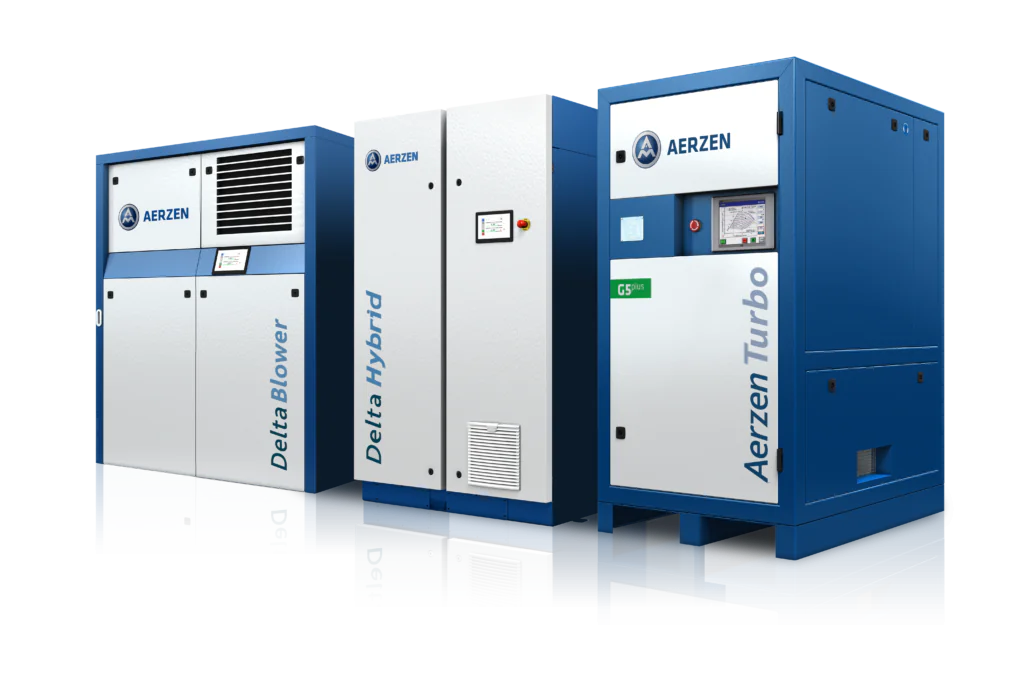
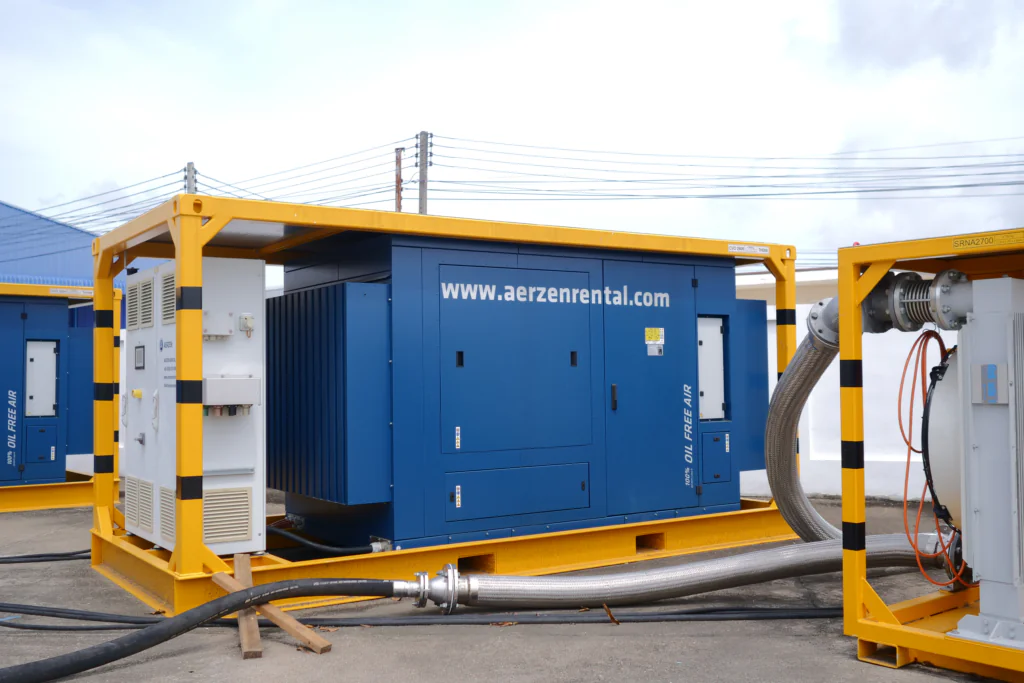
For oil content, ISO 8573-1 Class 0 (user-defined, most stringent) is achieved only by oil-free machines — no amount of downstream filtration converts an oil-lubricated compressor output to certified Class 0. AERZEN rental units in the oil-free series (DVO Delta Hybrid Screw, BVS Delta Screw, BVO Delta Screw) deliver oil-free air at the source, before any downstream filter is applied.
Micron Rating: Absolute vs Nominal
Before selecting a micron rating, it is necessary to understand what the rating actually means.
Nominal micron rating — the element captures a stated percentage (typically 50–98%) of particles at the stated size. A “5 µm nominal” element captures 95% of particles at 5 µm, but passes some fraction of larger particles. Nominal ratings are inconsistent across manufacturers because the test percentage varies.
Absolute micron rating (β-ratio, ISO 16889) — defined using the multi-pass test per ISO 16889 (available at: https://www.iso.org/ — verified 2026-05-08). The β-ratio expresses filtration ratio:
β_x = (N_upstream particles ≥ x µm) / (N_downstream particles ≥ x µm)A β₅ = 200 means the element passes 1 particle for every 200 that approach it at ≥ 5 µm — equivalent to 99.5% efficiency at 5 µm absolute.
Recommendation for rental applications: Always specify elements using absolute micron rating (β-ratio). Nominal ratings from different suppliers are not comparable and can result in incorrect element selection when sourcing replacements mid-rental.
DP Curve Across a Rental Period
A new filter element has a low “clean ΔP” — the resistance it presents to airflow when not yet loaded with particles. As the element captures contaminants, ΔP rises. This is called the loading curve.
The shape of the loading curve depends on:
- Inlet particulate concentration — higher load = faster ΔP rise
- Element media grade — finer media (lower micron rating) loads faster under coarse particulate
- Face velocity — higher air velocity through the element face = steeper loading
- Element surface area — larger area = slower ΔP rise per unit time
Typical ΔP profile for a 12-month rental period (illustrative, AERZEN field observation, worked example):
- Month 0–2: Clean ΔP 15–25 mbar (factory-fresh element in ambient-particulate environment)
- Month 3–5: ΔP rises to 40–60 mbar as element surface loads
- Month 6–8: ΔP reaches 70–100 mbar — approaching replacement threshold
- Month 8+: If not replaced, ΔP can reach 150–200+ mbar, increasing compressor differential pressure and energy consumption proportionally
The standard replacement trigger in most industrial applications is ΔP = 2× clean ΔP or a fixed threshold (commonly 100 mbar for coalescing filters, 150 mbar for particulate filters). Each OEM sets its own threshold — always consult the unit datasheet.
Selecting the Right Micron Rating for Your Application
Step 1 — Define downstream air quality requirement
Reference ISO 8573-1 class for your process. If the process requires Class 1 (solid particles), you need filtration down to sub-micron levels at the filter outlet.
Step 2 — Map filter stages
Industrial compressed air systems typically use multi-stage filtration:
| Stage | Filter Type | Typical Rating | Purpose |
|---|---|---|---|
| Pre-filter (coarse) | Particulate | 3–10 µm absolute | Protect downstream filters, remove bulk particulate |
| Mid-filter | Coalescing | 1–3 µm absolute | Remove liquid aerosol and fine particles |
| Final filter | Sub-micron / activated carbon | 0.01–0.1 µm | Remove residual aerosol, odor for Class 1/2 |
For oil-free rental units (AERZEN DVO/BVO/BVS), the coalescing stage is simplified because there is no compressor oil in the air stream to coalesce. The pre-filter and final particulate filter remain necessary depending on ambient conditions.
Step 3 — Match face velocity to ΔP budget
Higher face velocity reduces element life and increases ΔP. As a rule of thumb, size the filter housing so that face velocity does not exceed 1.5 m/s for coalescing elements and 2 m/s for particulate elements at rated flow.
If the rental unit operates at variable load (VSD-equipped), verify that at minimum flow, the reduced velocity does not fall below the drainage velocity required for coalescing elements — typically 0.3 m/s minimum.
Step 4 — Account for compressed air temperature
Filter element efficiency is rated at a reference temperature (commonly 20°C). Higher temperatures reduce coalescing efficiency for oil aerosol. In Thai ambient conditions where aftercooler outlet air can reach 35–45°C, verify that the selected element is rated for operating temperature without de-rating.
AERZEN Field Case: Filter Selection in Pharmaceutical Production (illustrative example)
Context (anonymized): A pharmaceutical ingredient manufacturer in the Central region rented an AERZEN DVO oil-free compressor for a 9-month production campaign. Initial filter specification used nominal-rated elements sourced locally.
Problem observed at month 3: Particle counts at process point exceeded ISO 8573-1 Class 1 limits during quarterly quality audit. Compressor ΔP was also 40% higher than specification, causing the VSD to operate at higher frequency than design.
Investigation findings:
- Local elements rated “5 µm nominal” were verified by the element supplier as β₅ = 10 (90% efficiency at 5 µm) — insufficient for Class 1 compliance
- Element face velocity was 2.8 m/s (exceeded recommended maximum of 1.5 m/s for coalescing stage) due to undersized housing
Corrective action with AERZEN support:
- Replaced elements with OEM-specified absolute-rated elements (β₁ = 1,000 per ISO 16889)
- Added parallel filter housing to reduce face velocity to 1.4 m/s
- Implemented weekly ΔP monitoring via digital manometer with data logger
Outcome: Process point returned to Class 1 compliance at next quarterly audit. VSD frequency returned to design range. Element service interval extended from 6 weeks to 14 weeks — reducing filter change events from 6 to 2.5 across the remainder of the rental period.
DP Monitoring Strategy During Rental
A filter replacement strategy driven only by calendar interval is inefficient — some sites load elements in 6 weeks, others in 16 weeks. ΔP monitoring-driven replacement is more precise.
Recommended approach:
- Install differential pressure gauge (or digital manometer with 4–20 mA output) across each filter stage at rental commissioning
- Record clean ΔP on day 1 — this is your baseline
- Set replacement alarm at 2× clean ΔP — configure alert if element not replaced before this threshold
- Log ΔP weekly — trend analysis reveals inlet air quality deterioration (step-change in ΔP curve) that may require site investigation
- Document replacement dates and ΔP at replacement — this data is valuable for predicting service intervals on future rental projects at similar sites
AERZEN rental units include pressure ports at filter inlet and outlet as standard. If your unit does not have a permanent gauge, a portable calibrated manometer can be used during scheduled walk-rounds.
Frequently Asked Questions
Q1: Can I use third-party filter elements on a rental unit without voiding the service agreement?
This depends on the rental agreement terms. AERZEN recommends OEM-specified elements because they are validated against the machine’s duty point and ISO 8573-1 compliance claims. Third-party elements with equivalent β-ratio certification and operating conditions may be acceptable — confirm in writing with AERZEN before substitution.
Q2: What happens if I let ΔP rise too high without replacement?
Beyond energy waste, excessive ΔP creates two additional risks: (1) element bypass — most filter housings have a bypass cracking pressure and if ΔP exceeds this limit, contaminated air bypasses the element entirely; (2) element collapse — high ΔP mechanical force can deform or rupture the element media, releasing captured contaminants downstream as a pulse.
Q3: For oil-free rental compressors, do I still need coalescing filters?
Oil-free machines (AERZEN DVO/BVO/BVS) do not introduce compressor lubricant into the air stream. However, ambient air may contain oil mist from nearby machinery, vehicle exhaust, or process equipment. A coalescing stage at the point of use is recommended if the ambient environment contains oil aerosol — verify by measuring ISO 8573-1 total oil content at the inlet before specifying filter stages.
Q4: How do I specify replacement filter elements when the rental unit is from overseas stock?
AERZEN Rental Thailand maintains a local parts inventory. Specify the unit model number and serial number, and AERZEN will supply OEM-matched elements for the rental period. This avoids the risk of dimension mismatch or rating incompatibility when sourcing locally.
Q5: Is there a performance guarantee on air quality if I use OEM elements?
AERZEN oil-free units are factory-verified for Class 0 air delivery at the machine outlet. Downstream air quality at the process point depends on the integrity of the piping system, filter elements, and absence of contamination from fittings or storage. AERZEN can advise on system layout to maintain Class compliance from unit to process.
Q6: What is the correct disposal method for used filter elements?
Used particulate filter elements from oil-free compressors are typically classified as non-hazardous solid waste (confirm with your site environmental officer based on local regulation). Used coalescing elements from oil-lubricated compressors require handling as oily waste per Thai industrial waste regulations (Factory Act B.E. 2535 and subsequent amendments). AERZEN can advise on proper handling procedure at element change.
Next Steps
Correct filter element selection at the start of a rental period, combined with ΔP monitoring throughout, is the single most cost-effective reliability intervention available to a maintenance manager.
To discuss filter specification for your rental unit or to request a technical brief on air quality management for your specific process, contact AERZEN Rental Thailand:
AERZEN Rental Thailand
- Office: 038-015-488
- 24/7 Hotline: 098-323-2626
- Email: thai@aerzenrental.com
- Website: www.aerzenrentalth.com
Rent a solution. Expect performance.
References
- ISO 8573-1:2010 Compressed air — Part 1: Contaminants and purity classes. International Organization for Standardization. Available at: https://www.iso.org/ (verified 2026-05-08)
- ISO 16889:2008 Hydraulic fluid power — Filters — Multi-pass method for evaluating filtration performance of a filter element. International Organization for Standardization. Available at: https://www.iso.org/ (verified 2026-05-08)

✍️ เกี่ยวกับผู้เขียน
ภราดร วรรณสังข์ (Paradorn Wannasung)
Marketing Communication Specialist · นิเทศศาสตรมหาบัณฑิต (การสื่อสารการตลาดและแบรนด์)
ภราดร (Paradorn) เป็นผู้ดูแลด้านการสื่อสารการตลาดของ AERZEN Rental Thailand จบนิเทศศาสตรมหาบัณฑิต (การสื่อสารการตลาดและแบรนด์) เชี่ยวชาญด้านอุตสาหกรรม B2B ในประเทศไทย มีประสบการณ์การสร้างแบรนด์และคอนเทนต์ในกลุ่มอุตสาหกรรมของไทย
ติดต่อ: pwa@aerzenrental.com · LinkedIn