
Since AERZEN’s founding in 1864, the company has understood that capital equipment decisions require more than engineering justification — they require financial rigor. For CFOs evaluating compressed air infrastructure, the Weighted Average Cost of Capital (WACC) provides a disciplined framework to compare the true cost of ownership across procurement pathways: outright purchase, finance lease, and rental subscription.
The CFO’s Challenge with Compressed Air
Compressed air and blower systems present a financial evaluation challenge that differs from most capital equipment:
- Variable utilization — Demand fluctuates with production cycles, seasonal load, and regulatory requirements
- Long asset life vs. rapid technology change — Physical assets last 15-20 years, but energy efficiency standards and controls evolve faster
- Hidden operating costs — Maintenance, energy, insurance, and compliance costs often exceed the capital cost over an asset’s life
- Regulatory compliance risk — ISO 8573-1 Class 0 requirements for electronics and food production can trigger unplanned capital events
A decision framework anchored in WACC allows CFOs to evaluate these variables with financial discipline rather than relying solely on engineering procurement recommendations.
WACC Fundamentals — A Brief Recap
Weighted Average Cost of Capital (WACC) represents the blended cost of all capital sources used by a company, weighted by their proportion in the capital structure.
The Standard Formula
WACC = (E/V × Re) + (D/V × Rd × (1 - Tc))Where:
- E = Market value of equity
- D = Market value of debt
- V = Total capital (E + D)
- Re = Cost of equity (using CAPM or dividend growth model)
- Rd = Cost of debt (pre-tax)
- Tc = Corporate tax rate
Application to Capital Budgeting
WACC serves as the hurdle rate for Net Present Value (NPV) calculations. An investment is value-accretive only when:
NPV = Σ [CF_t / (1 + WACC)^t] - Initial Investment > 0Where CF_t represents net cash flows in period t.
Reference: Damodaran, A. (2012). Investment Valuation: Tools and Techniques for Determining the Value of Any Asset (3rd ed.). Wiley Finance. — verified 2026-05-08
Three Procurement Pathways — Financial Structure Comparison
For a representative industrial blower installation (100 kW rated power, single unit, 24/7 operation), the three pathways create fundamentally different financial structures:
Pathway 1: Outright Capital Purchase
- Capital outlay: Full purchase price in Year 0
- Balance sheet impact: Asset capitalized at cost; depreciation over useful life (typically 10-15 years under Thai GAAP / TFRS)
- WACC relevance: Full capital committed immediately; weighted against both equity and debt cost
- Off-balance sheet: None — full asset and liability reflected
- Risk profile: Technology obsolescence risk retained by buyer; maintenance cost variability borne internally
NPV calculation note: The discount rate applied must be the company’s WACC. A higher WACC (typical for SME manufacturers in Thailand: 9-13%) significantly increases the present value of future maintenance and operating cash outflows — eroding the apparent “ownership advantage.”
Pathway 2: Finance Lease
- Capital outlay: Initial deposit + periodic lease payments
- Balance sheet impact: Asset and lease liability recognized under TFRS 16 (effective for Thai listed entities)
- WACC relevance: Lease liability increases D/V ratio; if not offset by equity, WACC may rise
- Risk profile: Similar to ownership for maintenance and technology risk
Pathway 3: Rental / Operational Subscription
- Capital outlay: Periodic rental payments only (OPEX treatment)
- Balance sheet impact: Under TFRS 16, short-term leases (≤ 12 months) or low-value assets may qualify for simplified treatment — finance teams should verify classification with auditors
- WACC relevance: No incremental debt → D/V ratio unchanged → WACC not degraded by this transaction
- Risk profile: Technology and maintenance risk transferred to rental provider; rapid flexibility to scale up or down
Reference: TFRS 16 Leases — Accounting standard applicable to Thai entities — https://www.tfac.or.th/ — verified 2026-05-08
WACC-Adjusted NPV: Why the Comparison Shifts Under High Hurdle Rates
The relationship between WACC and procurement pathway advantage is non-linear. Consider the following illustrative sensitivity analysis:
Illustrative Scenario (ตัวอย่างสมมติ — not a specific customer case)
Assumptions:
- Equipment: Industrial blower package suitable for wastewater or process air
- Operating period: 5 years
- Energy and maintenance costs are directionally representative of a mid-sized industrial application
- Annual savings from energy-efficient unit vs. legacy baseline: qualitative improvement — contact AERZEN for site-specific data
Observation at WACC = 8%: Outright purchase may show positive NPV if the capital cost is low relative to the long-term operational savings. The hurdle rate is low enough that future savings retain high present value.
Observation at WACC = 12%: Future cash flows are discounted more aggressively. A rental structure that eliminates the upfront capital event and converts fixed costs to variable OPEX may produce a superior risk-adjusted return, even if the nominal total payment is higher — because it preserves working capital and WACC remains unchanged.
Observation at WACC = 15%+ (common in leveraged SME contexts): Capital commitment in Year 0 is acutely penalized. Rental subscription structures become strongly advantaged on NPV terms, particularly when combined with AERZEN’s all-inclusive Subscription Plan (maintenance, engineering support, and emergency response included).
Key insight for CFOs: The higher the WACC, the greater the NPV advantage of structures that defer or eliminate capital commitment. This is mathematically rigorous, not a rental-industry marketing claim.
Practical Application — Decision Variables for Thai Manufacturers
Step 1: Establish Your WACC
Work with your CFO or treasury team to determine the current WACC for your entity. For Thai manufacturers, indicative components often include:
- Cost of equity (Re): 10-15% range (reflecting Thai market risk premium + company-specific risk)
- Cost of debt (Rd): 4-7% (commercial bank lending rate, 2024-2026 environment)
- Tax rate (Tc): 20% standard corporate tax rate in Thailand
- Capital structure (E:D ratio): Varies significantly by sector and leverage
Step 2: Map the Investment Horizon
Compressed air decisions are rarely one-size-fits-all:
- Short-term project (6-18 months): Rental dominates on NPV, flexibility, and WACC preservation
- Medium-term (2-5 years): Subscription Plan with fixed OPEX provides budget certainty; NPV comparison depends on WACC and maintenance assumptions
- Long-term (5+ years with high certainty of demand): Purchase or finance lease may become competitive — subject to technology refresh risk assessment
Step 3: Quantify Technology Refresh Risk
An 18 kW blower purchased in 2010 consumes materially more energy than a 2024 equivalent using Variable Speed Drive technology. This “stranded asset risk” has a present value that must be incorporated into the purchase NPV calculation.
AERZEN Rental Subscription Plans include access to current-generation TVO, DVO, and BVO machines — meaning the technology refresh risk is borne by AERZEN, not the customer.
Step 4: Assess Balance Sheet Objectives
If the company has covenant ratios, credit rating targets, or near-term financing requirements that are sensitive to D/V or asset turnover ratios, the TFRS 16 classification of any lease or rental agreement becomes material. CFOs should obtain a formal accounting opinion before committing to structures that may trigger reclassification.
AERZEN Subscription Plan — Financial Structure Overview
AERZEN Rental Thailand offers a Subscription Plan designed to address the financial considerations outlined above:
- All-inclusive OPEX model: Single periodic payment covers machine, preventive maintenance, consumables, and 24/7 technical support
- No capital commitment: Preserves cash and WACC position
- Flexible contract terms: Structured for both short-term projects and multi-year production requirements
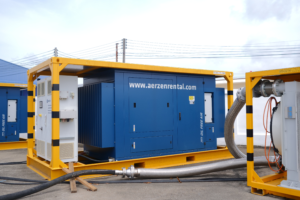
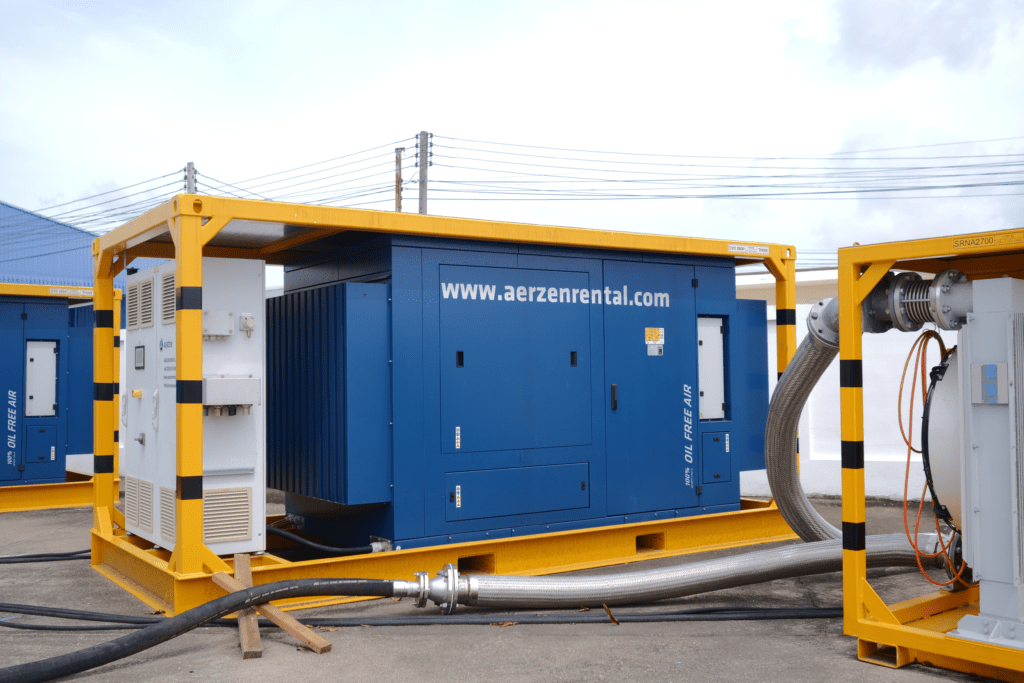
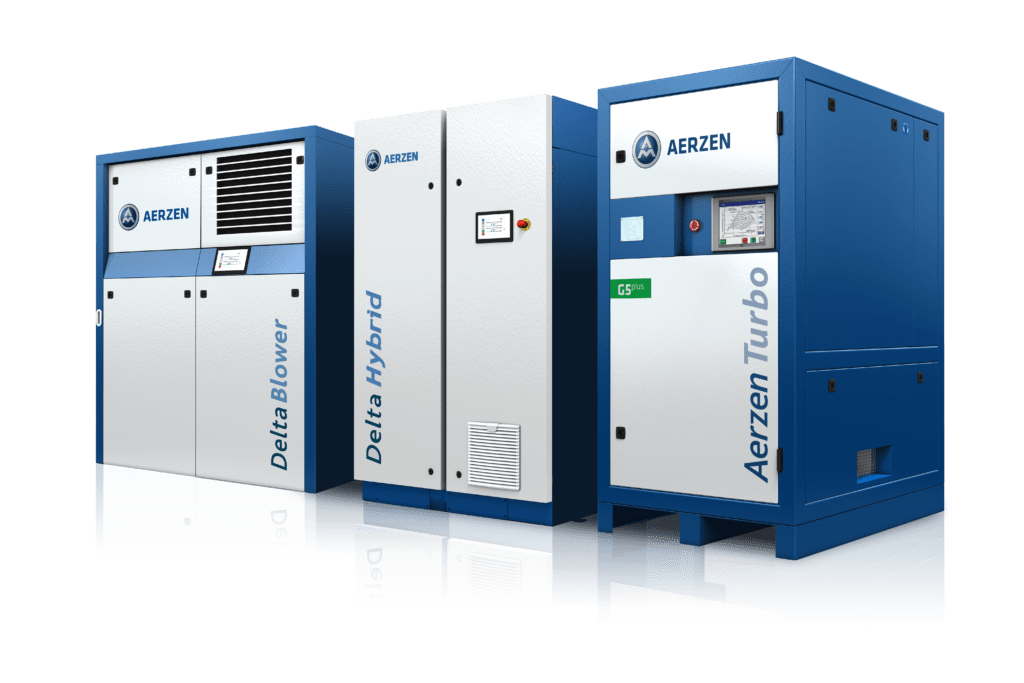
- Machine options: AERZEN TVO (Turbo Blower), DVO (Delta Hybrid Screw), BVO (Delta Screw), BVS (Rotary Lobe Roots) — sized to application
Pricing is structured per application. Contact the AERZEN Rental Thailand engineering team for a quotation tailored to your site conditions, operating hours, and required ISO 8573-1 quality class.
Frequently Asked Questions
Q1: How does WACC affect the rent-vs-buy decision mathematically?
WACC is the discount rate applied to all future cash flows in the NPV calculation. A higher WACC reduces the present value of future operational savings, making it harder for a capital-intensive purchase to generate positive NPV. Rental structures that convert capital costs to current-period OPEX are unaffected by this discounting effect on the initial outlay.
Q2: Does TFRS 16 eliminate the balance sheet advantage of rental?
Not entirely. TFRS 16 requires capitalization of right-of-use assets for most leases, but short-term leases (12 months or less) and low-value asset leases may qualify for simplified treatment. The specific classification depends on contract terms and should be confirmed with your auditor and reference to the TFAC guidance.
Q3: Is there a standard WACC for Thai manufacturing companies?
No single standard applies. WACC varies by capital structure, debt cost (which changes with interest rate environments), and equity risk premium assumptions. CFOs should calculate entity-specific WACC rather than applying an industry average.
Q4: Can AERZEN provide financial modeling support for investment decisions?
AERZEN Rental Thailand’s engineering and commercial team can provide technical specifications, energy performance data, and life-cycle cost structures to support your internal financial modeling. We do not provide financial advisory services — we provide the technical inputs that your finance team needs.
Q5: What discount rate should be applied if we use an internal hurdle rate instead of WACC?
Many companies use an internal hurdle rate (often WACC + a risk premium) for project evaluation. If your internal hurdle rate is higher than WACC, this further strengthens the NPV case for OPEX-based rental structures. Apply the same logic: higher discount rate → greater advantage to deferring capital commitment.
Q6: How long has AERZEN been providing rental services in Thailand?
AERZEN Rental Thailand operates as part of the AERZEN Group, a German engineering company established in 1864. The rental and subscription model has been developed with the same engineering standards that underpin AERZEN’s manufacturing operations globally.
Summary
For CFOs evaluating compressed air investment, WACC is not merely an accounting input — it is the disciplined lens through which the true cost of each procurement pathway becomes visible. As WACC rises, the NPV advantage of OPEX-based rental and subscription structures increases, because they eliminate the capital commitment in Year 0 and convert future cost variability into predictable periodic payments.
AERZEN Rental Thailand’s Subscription Plan is structured to align with this financial reality: no capital commitment, predictable OPEX, maintenance included, and technology access to current-generation AERZEN machines built on 160 years of German engineering precision.
Contact AERZEN Rental Thailand
To request a quotation or technical brief for your investment evaluation:
- Office Tel: 038-015-488
- Hotline 24/7: 098-323-2626
- Email: thai@aerzenrental.com
- Website: www.aerzenrentalth.com
Pricing depends on machine specification, operating requirements, and contract duration. Contact the team to receive a proposal tailored to your plant.
_”Rent a solution. Expect performance.”_

✍️ เกี่ยวกับผู้เขียน
ภราดร วรรณสังข์ (Paradorn Wannasung)
Marketing Communication Specialist · นิเทศศาสตรมหาบัณฑิต (การสื่อสารการตลาดและแบรนด์)
ภราดร (Paradorn) เป็นผู้ดูแลด้านการสื่อสารการตลาดของ AERZEN Rental Thailand จบนิเทศศาสตรมหาบัณฑิต (การสื่อสารการตลาดและแบรนด์) เชี่ยวชาญด้านอุตสาหกรรม B2B ในประเทศไทย มีประสบการณ์การสร้างแบรนด์และคอนเทนต์ในกลุ่มอุตสาหกรรมของไทย
ติดต่อ: pwa@aerzenrental.com · LinkedIn