As AERZEN has engineered compressed air systems since 1864, the turbo blower platform has always represented the intersection of thermodynamic precision and large-volume air delivery. The TVO+ series — AERZEN’s oil-free turbo blower range — applies three-stage centrifugal compression to achieve flow rates that neither positive-displacement nor single-stage turbo designs can match efficiently in the 1,000–30,000 Nm³/h range. This article provides plant engineers with the technical framework to evaluate whether TVO+ is the correct architecture for their application.
Why Three Stages — The Thermodynamic Argument
Single-stage centrifugal blowers achieve moderate compression ratios in one pass. When pressure ratio exceeds approximately 1.8:1 (rough threshold dependent on blade geometry and tip speed), single-stage designs lose isentropic efficiency rapidly. Two-stage designs extend this range but still face limits above 2.5:1. Three-stage design solves this by dividing the total pressure rise across three impeller stages with interstage cooling between each.
Intercooling benefit — step-by-step:
For a three-stage turbo blower delivering outlet pressure of 900 mbar(g) from atmospheric inlet at 1,013 mbar(a):
This means each stage handles only a 23.7% pressure rise — well within the efficiency envelope of a well-designed centrifugal impeller. Without staging, a single impeller would face an 88.8% pressure rise, driving tip speed into compressibility effects and significantly degrading efficiency.
Isentropic work calculation (ideal, for reference):
For air (γ = 1.4, R = 287 J/kg·K), inlet temperature T₁ = 308 K (35°C):
“ Isentropic specific work (single stage): w_s = [γ/(γ-1)] × R × T₁ × [(P₂/P₁)^((γ-1)/γ) − 1] w_s = [1.4/0.4] × 287 × 308 × [(1.888)^(0.286) − 1] w_s = 3.5 × 287 × 308 × [1.196 − 1] w_s = 3.5 × 287 × 308 × 0.196 w_s = 3.5 × 17.363 × 0.196 w_s ≈ 11.9 kJ/kg `
With intercooling returning air to T₁ = 308 K between each stage:
` Per-stage isentropic work: w_stage = 3.5 × 287 × 308 × [(1.237)^(0.286) − 1] (1.237)^(0.286) = e^(0.286 × ln(1.237)) = e^(0.286 × 0.2127) = e^(0.0608) ≈ 1.0627 w_stage = 3.5 × 287 × 308 × 0.0627 w_stage ≈ 3.5 × 287 × 308 × 0.0627 ≈ 1.94 kJ/kg
Total 3-stage with perfect intercooling: 3 × 1.94 = 5.82 kJ/kg “
Energy saving vs single-stage (ideal comparison): (11.9 − 5.82) / 11.9 ≈ 51% reduction in theoretical specific work.
In practice, intercooling is imperfect and mechanical losses exist — realistic efficiency gains are 20–35% versus single-stage, but this still represents substantial power savings at high flow rates.
TVO Platform Overview — AERZEN Turbo Designation
AERZEN’s TVO Series (Oil-Free Screw) uses permanent-magnet motor technology, active magnetic bearings, and variable speed drive integration in a single compact unit. Key characteristics relevant to high-flow configuration:
Bearing technology: Active Magnetic Bearings (AMB) eliminate mechanical contact between rotating shaft and housing. This means:
Motor — Permanent Magnet synchronous: PM motors maintain high power factor and efficiency at partial loads. At 60–80% load (typical real-world operating point for blowers with variable demand), PM motor efficiency remains above 96% vs induction motor efficiency degrading to 88–91% at same partial load. This is significant for operating cost over 8,000+ hour annual run times.
VFD integration: The TVO+ is designed for Variable Frequency Drive operation from the factory. Speed range is typically 15,000–40,000 RPM (model dependent). Flow modulation via speed change is more efficient than throttling or bypass control — system curve intersection shifts proportionally with speed squared law.
Reference: AERZEN TVO product specification sheet (consult current datasheet at
High-Flow Applications — Where TVO+ Architecture Fits
The three-stage TVO+ configuration is matched to applications where:
Application-by-application fit assessment:
| Application | Typical Flow Range | Pressure Range | TVO+ Fit |
|—|—|—|—|
| Municipal wastewater aeration | 5,000–25,000 Nm³/h | 400–700 mbar(g) | High — large basin aeration |
| Petrochemical tank blanketing | 2,000–8,000 Nm³/h | 100–300 mbar(g) | Medium — may prefer 2-stage |
| Pneumatic conveying (light material) | 1,500–6,000 Nm³/h | 500–900 mbar(g) | High |
| Flue gas desulfurization (FGD) | 8,000–30,000 Nm³/h | 400–600 mbar(g) | High — flagship application |
| Electronics cleanroom | 500–2,000 Nm³/h | 200–500 mbar(g) | Medium — DVO/BVO may be sufficient |
Three-Stage vs Two-Stage vs Positive Displacement — Decision Framework
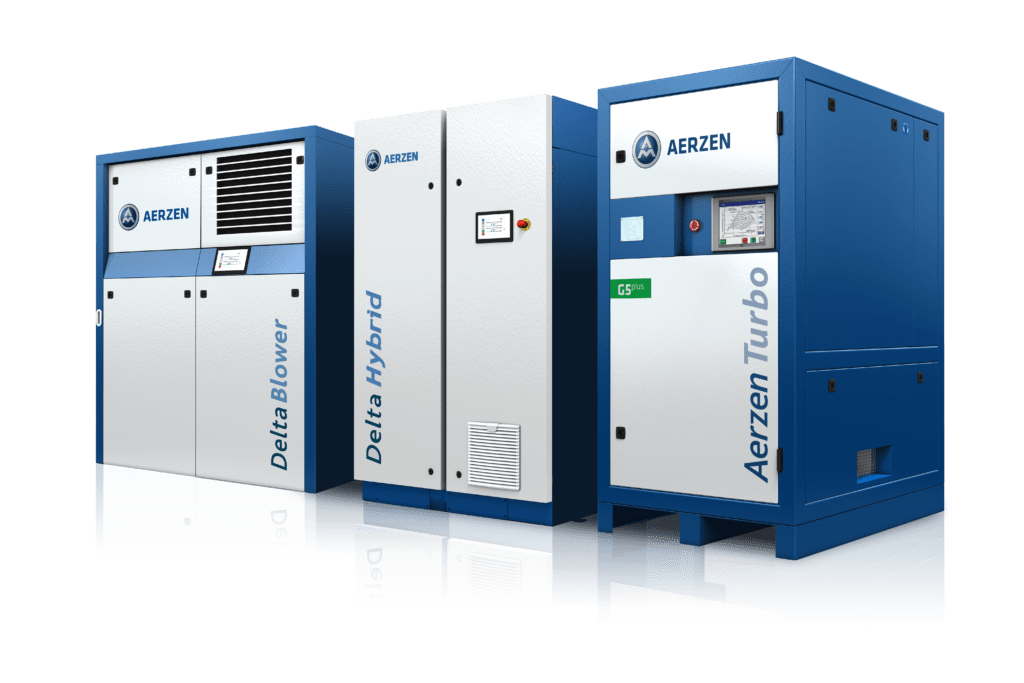
Plant engineers frequently ask whether three-stage turbo, two-stage turbo, or positive-displacement (DVO Delta Hybrid Screw / BVO Delta Screw) is the correct selection. The answer depends on three variables:
Variable 1: Flow rate
Variable 2: Pressure stability Centrifugal machines have a characteristic curve where flow and pressure are interdependent. At low flow on the curve, surge risk exists. Three-stage TVO+ with AMB and integrated surge control manages this actively — the machine monitors discharge pressure and adjusts speed to avoid surge region. Positive-displacement machines have a flat pressure curve — flow varies nearly linearly with speed, with no surge risk. For applications with highly variable demand and low predictability, PD machines (DVO, BVO, GMa, GMb) offer simpler control.
Variable 3: Specific energy (kWh/Nm³) At design point, three-stage TVO+ achieves specific energy in the range of 0.06–0.09 kWh/Nm³ for 500–700 mbar(g) delivery (application dependent). For comparison:
Note: These ranges are indicative for engineering comparison — actual specific energy depends on inlet conditions, outlet pressure, and VFD setting. Request site-specific calculations from AERZEN engineering team.
Surge Control and Operating Map
Surge is the primary risk in centrifugal compressor operation — it occurs when inlet flow drops below the minimum flow required to maintain stable compression, causing rapid reverse flow and potentially damaging vibration.
TVO+ surge management mechanism:
This multi-layer approach allows TVO+ to operate closer to the surge line than older turbo designs — meaning more of the performance map is usable, which translates to better part-load efficiency.
Case Study: High-Flow Wastewater Aeration Upgrade (illustrative example)
A municipal wastewater treatment plant (worked example — hypothetical for instructional purposes) operating a 40,000 m³/day biological treatment basin required replacement of two aging lobe-blower units during their 10-year capital refresh cycle.
Original installation:
Replacement evaluation: The engineering team evaluated three-stage TVO+ rental for a 24-month validation period before committing to CAPEX purchase:
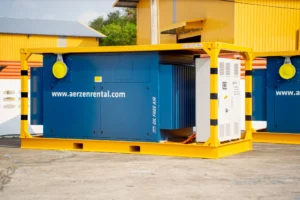
The rental model allowed the plant to validate performance over a full seasonal cycle (including peak biological oxygen demand in summer) before committing to purchase, with full maintenance responsibility held by AERZEN during the rental period.
Frequently Asked Questions
Q1: What is the difference between TVO and TVO+? A: TVO is AERZEN’s core turbo blower designation (Turbo Verdichter Oel-frei). The “+” designation in market positioning typically refers to the enhanced control package, including full AERZEN AERsmart monitoring integration and advanced surge control. Confirm current model nomenclature with the AERZEN engineering team as product generations evolve.
Q2: Can TVO+ operate in parallel with existing positive-displacement blowers? A: Yes, with careful control system integration. The key challenge is that the TVO+ pressure curve is non-linear while PD machines produce near-flat curves. Parallel operation requires a master controller (typically SCADA or dedicated blower controller) managing lead/lag logic. AERZEN engineers can specify the control philosophy for parallel configurations.
Q3: What maintenance does TVO+ require during rental period? A: Active Magnetic Bearings have no wear parts in normal operation. Scheduled maintenance covers filter elements, cooler inspection, and control system calibration. Under AERZEN rental agreements, scheduled and unscheduled maintenance is managed by AERZEN — the plant only provides utilities (power, cooling water if applicable) and reports alarms. Contact AERZEN for specific SLA terms: 038-015-488.
Q4: What is the minimum flow TVO+ can sustain without surge? A: Minimum stable flow is typically 50–60% of design flow at fixed pressure, but the exact surge line depends on operating pressure. With VFD speed reduction, the operating range extends because both the machine curve and surge line shift simultaneously. Site-specific performance maps should be reviewed with AERZEN before installation.
Q5: Is ISO 8573-1 Class 0 guaranteed for TVO+? A: The TVO+ uses Active Magnetic Bearings — no oil contacts the airstream by mechanical design. ISO 8573-1 Class 0 is a user-defined standard specifying that total oil content (aerosol + vapour + liquid) is below a level agreed between user and supplier. AERZEN engineers can confirm the applicable oil class certification for the specific unit — verify current certification documentation at point of quotation.
Q6: What electrical supply does TVO+ require for Thailand installations? A: TVO+ units for the Thai market are typically configured for 380V/50Hz three-phase supply via integrated VFD cabinet. Confirm exact electrical specification and cable sizing requirements with AERZEN during the site survey. Contact: thai@aerzenrental.com.
Summary — When to Specify TVO+ Three-Stage
The three-stage TVO+ architecture provides the optimal solution when:
AERZEN has been engineering these systems since 1864 — not as a supplier relationship, but as an engineering partnership where the machine’s performance is the commitment.
Request a Technical Assessment for High-Flow Applications
AERZEN Rental Thailand’s engineering team provides site-specific performance calculations, operating map analysis, and rental configurations for TVO+ applications across Thailand and the EEC region.
Contact the engineering team:
*Rent a solution. Expect performance.*

✍️ เกี่ยวกับผู้เขียน
ภราดร วรรณสังข์ (Paradorn Wannasung)
Marketing Communication Specialist · นิเทศศาสตรมหาบัณฑิต (การสื่อสารการตลาดและแบรนด์)
ภราดร (Paradorn) เป็นผู้ดูแลด้านการสื่อสารการตลาดของ AERZEN Rental Thailand จบนิเทศศาสตรมหาบัณฑิต (การสื่อสารการตลาดและแบรนด์) เชี่ยวชาญด้านอุตสาหกรรม B2B ในประเทศไทย มีประสบการณ์การสร้างแบรนด์และคอนเทนต์ในกลุ่มอุตสาหกรรมของไทย
ติดต่อ: pwa@aerzenrental.com · LinkedIn
บทความที่เกี่ยวข้อง
หัวข้อหลัก: โบลเวอร์เทอร์โบ เทียบ โบลเวอร์สกรู