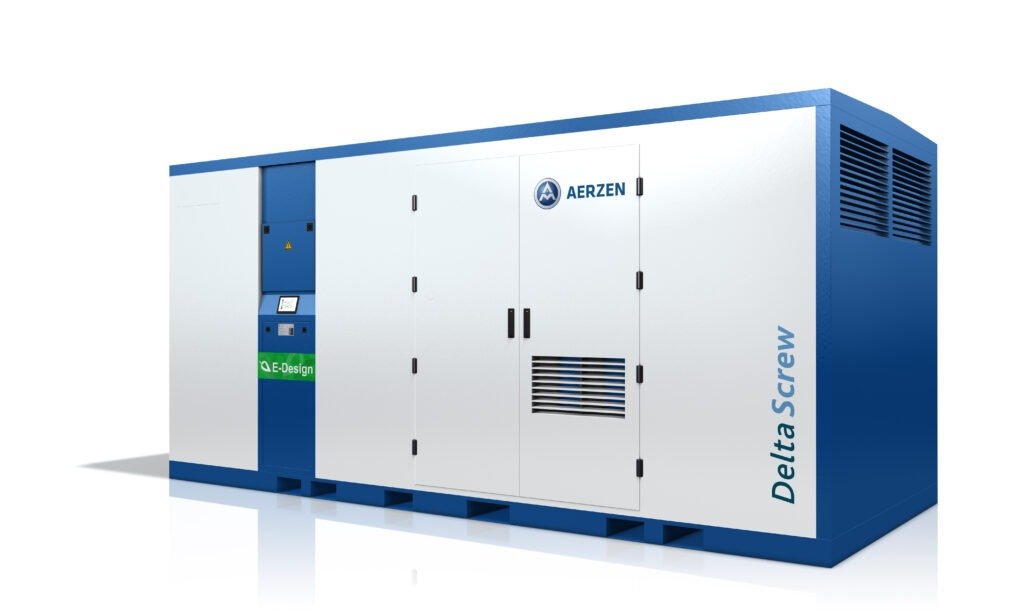
As AERZEN has designed and manufactured rotating machinery since 1864, one principle has remained constant across generations of blower and compressor technology: a machine that is monitored correctly from day one runs longer, fails less often, and costs less to maintain over its service life. The first 30 days after commissioning a rental unit are the highest-leverage window a Maintenance Manager has.
This protocol provides a structured approach to establishing a vibration baseline for rental blowers and compressors — one that gives your team defensible data from day one and the confidence to act when something changes.
Why the First 30 Days Matter
When a rental blower arrives on-site and is commissioned, it enters what reliability engineers call the “infant mortality” zone on the classic bathtub curve. Early-life failures — though relatively rare in well-maintained AERZEN units — tend to manifest within the first 200–500 operating hours. Vibration monitoring during this period serves two distinct purposes:
International standard ISO 10816-3:2009 (Mechanical vibration — Evaluation of machine vibration by measurements on non-rotating parts — Part 3: Industrial machines with nominal power above 15 kW and nominal speeds between 120 r/min and 15 000 r/min) provides the reference framework for evaluating vibration severity on the class of machines AERZEN Rental units fall within. Maintenance teams are advised to review this standard alongside AERZEN’s commissioning documentation. Reference: ISO 10816-3:2009, https://www.iso.org/
Equipment and Setup Before You Start
Before collecting the first data point, confirm the following:
Measurement equipment:
Measurement points — mark permanently with paint pen or engraved label:
Permanent marking is non-negotiable. Without consistent measurement points, trend data has no meaning.
Operating conditions to record with every measurement:
The 30-Day Protocol: Data Collection Schedule
Days 1–3: Commissioning Baseline (Intensive)
This is the most important data in the entire protocol. Collect immediately after commissioning is complete and the machine has reached thermal equilibrium (typically 30–45 minutes after start under load).
Day 1: Collect full vibration spectrum at all marked measurement points. Record overall velocity (mm/s RMS) and acceleration (g peak). Take a time waveform capture if your analyser supports it. This is your T0 baseline — protect this data.
Day 2: Collect at the same points, same conditions. Compare to Day 1. A stable reading within 5% of Day 1 confirms repeatable measurement technique. A reading outside 10% requires investigation of measurement method before proceeding.
Day 3: Confirm baseline stability. Archive Day 1, 2, and 3 data sets as your official commissioning baseline. This data set should be stored in the equipment file and, for rental units, shared with the AERZEN Rental technical team.
Days 4–14: Daily Monitoring (Overall Values)
Daily collection of overall vibration velocity (mm/s RMS) at the four primary bearing housing points (drive-end and non-drive-end, horizontal and vertical). Total measurement time per machine: approximately 8 minutes.
Purpose: Early detection of trend changes while the machine is still in the high-risk early-life window.
Alert threshold during Days 4–14: Flag for investigation if any single measurement point changes more than 20% from the Day 1 baseline, or if overall trend shows consistent upward direction across three consecutive days.
Days 15–21: Every-Other-Day Monitoring
By Day 14, the machine has typically demonstrated stable operation if no anomalies were found. Reduce to every-other-day collection. Continue overall values; add a full spectrum collection twice during this period (Day 15 and Day 20).
The full spectrum collection allows comparison of frequency components against the commissioning baseline. Emerging faults often appear first as changes in specific frequency bands (e.g., blade pass frequency, gear mesh frequency) before they elevate the overall level.
Days 22–30: Transition to Steady-State Cadence
Collect overall values three times per week. On Day 30, collect a final full spectrum. This Day 30 spectrum becomes the “30-day baseline” — a more reliable reference than Day 1 because it reflects the machine in its actual thermal and mechanical equilibrium with your system.
Review the Day 30 baseline against the Day 1 baseline:
After Day 30, the ongoing monitoring interval is typically weekly overall readings and monthly full spectrum, adjustable based on machine criticality and site risk tolerance.
ISO 10816-3 Vibration Severity Zones — Reference for Alert Thresholds
ISO 10816-3 defines four vibration severity zones for machines in the applicable class:
| Zone | Velocity (mm/s RMS) | Interpretation |
|—|—|—|
| Zone A | ≤ 2.3 | New or recently commissioned machine — acceptable for long-term operation |
| Zone B | 2.3 – 4.5 | Acceptable for unrestricted long-term operation |
| Zone C | 4.5 – 7.1 | Unsatisfactory for long-term operation — investigate |
| Zone D | > 7.1 | Danger — risk of machine damage, shut down and investigate |
Note: The above values are the general guidance from ISO 10816-3 for machines in the relevant power and speed class. Your AERZEN Rental commissioning engineer will provide machine-specific alert thresholds based on the actual unit delivered, which may differ from ISO table values depending on machine size, speed, and mounting configuration. Always use the machine-specific values as the primary reference.
These thresholds are provided here as a starting framework, not as a substitute for the commissioning documentation that accompanies each AERZEN Rental unit.
Fault Indicators to Watch in the First 30 Days
The following patterns in vibration data warrant immediate investigation:
1. Consistent upward trend in overall level Any point showing a steady increase — even if still within Zone A or B — over 5 or more consecutive measurements is a trend fault. Trends matter more than absolute values during the baseline period.
2. Elevated 1x running speed component A dominant 1x (one-times running speed) component in the FFT spectrum often indicates unbalance. If this is elevated from Day 1 and stable, it may reflect the as-delivered condition. If it grows, escalate.
3. Sub-synchronous vibration Vibration at frequencies below running speed (typically 0.4x–0.5x) can indicate rotor rub or fluid instability. This pattern requires immediate attention regardless of overall level.
4. High-frequency impacting Seen as elevated acceleration (g) values relative to velocity, high-frequency impacting can indicate early bearing defects. Use envelope analysis (demodulation) if your analyser supports it.
5. Step changes A step change — a measurement suddenly 30% or more above the previous — rather than a gradual trend is often associated with a discrete event (foreign object ingestion, fastener loosening, seal failure). Investigate immediately.
worked example Case: EEC Industrial Site (Anonymized)
A manufacturing plant in the Eastern Economic Corridor rented a positive displacement blower unit as a backup during planned maintenance on their primary system. The plant’s maintenance team used a modified version of this 30-day protocol.
On Day 11, the team detected a 22% increase in vibration velocity at the drive-end bearing housing, horizontal direction, compared to the Day 1 baseline. The overall level remained within ISO Zone B. Because the trend had been noted over four consecutive daily readings, the Maintenance Manager escalated to AERZEN Rental technical support.
Remote review of the trend data — shared via email — identified the pattern as consistent with a developing inlet filter restriction rather than a mechanical fault. Inspection confirmed partial blockage of the inlet filter element. Filter replacement was completed during a scheduled break without unplanned shutdown.
*Note: This case is a worked example for illustrative purposes. Actual outcomes vary by site conditions. Consult the AERZEN engineering team for case-specific analysis.*
FAQ
Q1: Does AERZEN Rental provide vibration baseline data from factory acceptance testing? AERZEN Rental units are tested before deployment. Commissioning engineers will share relevant acceptance test data where available. However, factory conditions differ from site conditions, which is why establishing a site-specific baseline on Days 1–3 is essential.
Q2: Can I use a smartphone vibration app instead of a calibrated analyser? Smartphone apps can provide approximate overall readings useful for a rough sanity check, but they are not suitable for establishing a defensible vibration baseline. The accelerometer in consumer devices is not calibrated, and frequency resolution is insufficient for fault diagnosis. For baseline data that will be used to make maintenance decisions, use calibrated equipment.
Q3: What if my measurement readings vary significantly between Days 1 and 2? First verify measurement technique: same point, same mounting pressure, machine at the same operating condition. If technique is consistent and readings still vary by more than 10%, contact the AERZEN Rental technical team before proceeding. The machine may need re-inspection.
Q4: How long should I keep vibration baseline records? For rental units, retain records for the duration of the rental contract plus 12 months, or as required by your plant’s document retention policy, whichever is longer. Good vibration records are also valuable if an insurance or liability question arises.
Q5: Does AERZEN offer remote vibration monitoring on rental units? Contact the AERZEN Rental Thailand team to discuss monitoring options available for your specific unit and rental configuration. Technology capabilities evolve — confirm current options with the technical team.
Q6: At what point should I escalate vibration concerns to AERZEN Rental support vs. handle internally? Internal investigation is appropriate for Zone B readings with stable trends. Escalate to AERZEN Rental technical support when: (a) any point enters Zone C, (b) a trend increase of more than 20% over baseline occurs within the 30-day window, or (c) any sub-synchronous or impacting pattern appears. Do not wait to escalate — early information allows better decisions.
Request Technical Support or Quote
AERZEN Rental Thailand’s technical team is available to support your vibration monitoring program for rental units — from commissioning baseline setup through ongoing monitoring consultation.
Contact:
*Rent a solution. Expect performance.*
References

✍️ เกี่ยวกับผู้เขียน
ภราดร วรรณสังข์ (Paradorn Wannasung)
Marketing Communication Specialist · นิเทศศาสตรมหาบัณฑิต (การสื่อสารการตลาดและแบรนด์)
ภราดร (Paradorn) เป็นผู้ดูแลด้านการสื่อสารการตลาดของ AERZEN Rental Thailand จบนิเทศศาสตรมหาบัณฑิต (การสื่อสารการตลาดและแบรนด์) เชี่ยวชาญด้านอุตสาหกรรม B2B ในประเทศไทย มีประสบการณ์การสร้างแบรนด์และคอนเทนต์ในกลุ่มอุตสาหกรรมของไทย
ติดต่อ: pwa@aerzenrental.com · LinkedIn