As AERZEN has engineered gas-handling systems since 1864, one of the most frequently misunderstood specifications in industrial compressed air is pressure dew point (PDP) — and the integration of dryer systems with blower or compressor packages is where that misunderstanding most often becomes a costly process problem.
This article is written for process engineers specifying or reviewing compressed air systems. It covers PDP fundamentals, ISO 8573-1 moisture classification, dryer technology selection, and the specific integration considerations when pairing dryers with oil-free blower packages.
What Is Pressure Dew Point and Why Does It Matter
Pressure dew point is the temperature at which water vapour in compressed air begins to condense into liquid — at the system operating pressure. It is distinct from atmospheric dew point, which is measured at ambient pressure (approximately 1 bar absolute).
The relationship between the two is pressure-dependent. A compressed air system operating at 7 bar(g) with an atmospheric dew point of −20 °C will have a pressure dew point of approximately +8 °C at line pressure (the conversion involves the ratio of absolute pressures). For this reason, specifications must always state whether a dew point value is measured at line pressure (PDP) or at atmospheric pressure (ADP) — conflating the two leads to undersized or over-specified dryers.
Why moisture control matters in process applications
Water in compressed air causes:
- Corrosion of distribution pipework, valves, and instrumentation
- Microbial growth in food, beverage, and pharmaceutical environments (water is a required condition for most relevant organisms)
- Pneumatic instrument malfunction — water freezes in outdoor or cold-storage distribution networks
- Product contamination in direct-contact applications
- Reduced filter element life due to filter cake saturation
ISO 8573-1:2010 (https://www.iso.org/) classifies moisture content in compressed air across Classes 1–9 using pressure dew point as the measurement unit. Class 1 specifies PDP ≤ −70 °C; Class 4 specifies PDP ≤ +3 °C. The appropriate class depends entirely on the application.
ISO 8573-1:2010 Moisture Classes — A Practical Reference
| Class | Pressure Dew Point (PDP) |
|---|---|
| 1 | ≤ −70 °C |
| 2 | ≤ −40 °C |
| 3 | ≤ −20 °C |
| 4 | ≤ +3 °C |
| 5 | ≤ +7 °C |
| 6 | ≤ +10 °C |
| 7 | ≤ 0 °C (liquid water content limit) |
| 8 | ≤ 10 g/m³ (liquid water content limit) |
| 9 | ≤ 850 g/m³ (liquid water content limit) |
For pharmaceutical manufacturing under PIC/S PE 009-16 (Annex 1), Class 2 (−40 °C PDP) is frequently the minimum specification for product-contact air. For food and beverage under ISO 22000, Class 4 or better is typical — though auditors increasingly expect Class 2 for direct-contact applications.
Dryer Technology Selection
There are four principal dryer technologies in industrial use. Selecting the correct one requires matching the required PDP, flow rate, and operating conditions — not simply specifying “the dryer that came with the package.”
Refrigerant Dryers
- PDP achievable: Typically +3 °C to +7 °C (ISO 8573-1 Class 4–5)
- Mechanism: Compressed air is cooled below its dew point; condensate is separated and drained
- Best for: General industrial applications not requiring sub-zero PDP; lower operating cost
- Limitations: Cannot achieve Class 3 or better; performance degrades at high ambient temperatures (a real constraint in Thai plant environments)
Desiccant Dryers — Heatless (Twin-Tower Pressure Swing Adsorption)
- PDP achievable: −40 °C to −70 °C (ISO 8573-1 Class 1–2)
- Mechanism: Adsorption of water vapour on activated alumina or molecular sieve; one tower dries while the other regenerates using purge air
- Best for: Critical process applications, outdoor distribution in cold climates, pharmaceutical
- Limitations: Purge air consumption (typically 15–20% of inlet flow); higher operating cost than refrigerant dryers
Desiccant Dryers — Heated (Internally or Externally Heated)
- PDP achievable: −40 °C to −70 °C (ISO 8573-1 Class 1–2)
- Mechanism: Regeneration uses heated air rather than purge air, reducing purge loss to 2–5%
- Best for: High-flow applications where purge loss is a significant operating cost
- Limitations: Higher capital cost and additional energy input for the heater
Membrane Dryers
- PDP achievable: Typically −20 °C to −40 °C (ISO 8573-1 Class 2–3) depending on design and inlet conditions
- Mechanism: Selective permeation of water vapour through hollow-fibre membrane
- Best for: Small, distributed point-of-use applications; environments where regeneration is impractical
- Limitations: Flow-dependent; PDP performance sensitive to inlet temperature and flow variation
Integration Considerations When Coupling Dryers with Oil-Free Blower Systems
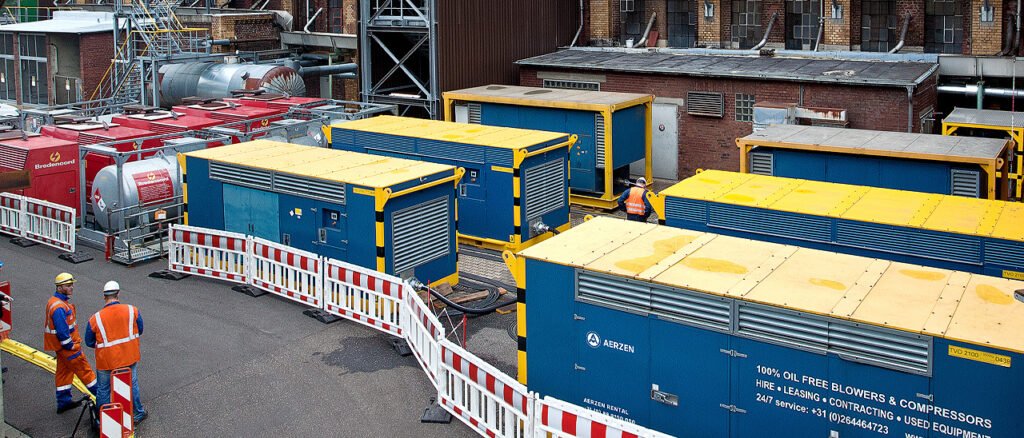
Oil-free systems — such as AERZEN’s BVO (Delta Screw) and DVO (Delta Hybrid Screw) — eliminate oil contamination at source, which simplifies the downstream treatment train considerably. However, integration of the dryer sub-system still requires careful engineering attention.
1. Pressure and Temperature at Dryer Inlet
Dryers are rated at specific inlet conditions: typically 7 bar(g) and 35 °C for standard industrial units. AERZEN BVO and DVO packages operating at different pressures or delivering air at higher discharge temperatures will need to be verified against the dryer’s performance curve. Discharge temperature from an oil-free screw unit at full load can reach 80–100 °C before aftercooler; the aftercooler must bring temperature down to within rated dryer inlet conditions.
Action: Always specify aftercooler approach temperature (typically ≤ 5 °C above cooling water temperature) and verify against the dryer’s rated inlet temperature.
2. Flow Rate Matching and Turndown
A critical integration failure mode is mismatching the dryer rating with the blower’s actual flow range, particularly for variable-speed drive (VSD) units. AERZEN’s AERprogress+ VSD control allows the DVO to operate across a wide flow range — the dryer must handle the full range, not just the nominal design point.
Desiccant dryers in particular require minimum inlet flow to maintain tower pressure differential for effective desiccant contact. Below minimum flow, PDP performance degrades. Refrigerant dryers are less sensitive to turndown but their minimum flow specification should still be verified.
3. Condensate Drain Specification
After-coolers and dryers produce liquid condensate that must be removed reliably. Electronic timed drains (zero-loss or demand-type) are preferable to float drains in systems where condensate flow is variable. In oil-free systems, condensate does not contain oil and can typically be directed to the drainage system without oil-water separation — verify with the site environmental officer if any lubricant is used elsewhere in the system.
4. Pre-filter and After-filter Positioning
ISO 8573-1 air quality is measured at the point of use. Desiccant particles from the dryer beds (alumina fines) can migrate downstream and become a particle contamination source. An after-filter rated to ISO 8573-1 Class 1 for particulate (≤ 0.1 μm particle size) should be installed downstream of the dryer.
Pre-filters upstream of the dryer should match the dryer manufacturer’s inlet requirements — typically removing particles > 1 μm and any liquid water aerosol to protect the desiccant bed.
5. PDP Monitoring and Alarm Integration
Continuous PDP monitoring at the dryer outlet — using a calibrated dew point transmitter — is recommended for Class 2 and above. The transmitter output should be integrated into the site SCADA or control system with high-PDP alarm setpoints. Without continuous monitoring, a failing desiccant bed may deliver out-of-specification air for days before the next manual check.
AERZEN’s AERtronic control interface can log and export operational data; integrating PDP sensor data into the same data stream simplifies compliance reporting for ISO 22000 and pharmaceutical audits.
Case Study: Pharmaceutical Plant Integration (illustrative example — not a real customer case)
A pharmaceutical dry-dosage facility in Thailand was operating an oil-flooded compressor with a refrigerant dryer. During a PIC/S audit preparation, air quality testing revealed PDP at the filling line of +5 °C — Class 5 — against a specification of −40 °C (Class 2) required by their validated process.
The root cause was two-fold: the refrigerant dryer was physically incapable of achieving −40 °C PDP, and the specification had been set during facility design but never verified against the installed equipment.
The facility transitioned to an AERZEN DVO oil-free package paired with a twin-tower heated regeneration desiccant dryer, sized for the validated flow and pressure. PDP at the point of use after commissioning: −42 °C, verified by an accredited external laboratory to ISO 8573-9.
The facility passed the subsequent audit with no major findings related to compressed air quality.
Note: Figures below are illustrative. Details are anonymized.
Specifying PDP in Purchase Orders and Rental Agreements
When procuring or renting a dryer system as part of a blower package, the specification should state:
- Required PDP at point of use (not at dryer outlet) and at system operating pressure
- Design flow rate and minimum expected flow rate (for turndown verification)
- Maximum inlet air temperature to the dryer
- Required ISO 8573-1:2010 moisture class
- Monitoring requirements (continuous PDP transmitter, alarm set-point, data logging)
- Verification method (on-site measurement or third-party laboratory)
AERZEN Rental Thailand provides oil-free packages with integrated aftercooling. Dryer selection and integration engineering can be discussed with the application engineering team prior to rental commencement.
FAQ
Q1: Can I use an atmospheric dew point meter to verify ISO 8573-1 moisture class? You can, but the reading must be converted to pressure dew point at the system operating pressure. Many portable instruments display both; always confirm which reading the instrument is reporting and at what reference pressure.
Q2: How often should desiccant beds be replaced? Desiccant life depends on moisture load, regeneration cycle quality, and the presence of contaminants (oil, particulates) that poison the desiccant. Manufacturers typically specify 3–5 years for activated alumina under normal conditions. Oil contamination can reduce this significantly — another reason oil-free source air extends dryer life.
Q3: Is a refrigerant dryer adequate for pharmaceutical applications? Generally not for product-contact air. Most pharmaceutical standards (PIC/S, USP Chapter 1238) require PDP well below what a refrigerant dryer can achieve. A desiccant dryer is the standard choice for Class 2 or better.
Q4: What happens if the desiccant dryer purge valve fails open? The affected tower will not regenerate properly; over time the desiccant saturates and PDP rises. A continuous PDP transmitter with alarm is the primary defence. Some dryers include purge flow verification as a standard diagnostic; specify this when purchasing or renting.
Q5: Does AERZEN rental cover the dryer as well as the compressor/blower? Equipment configuration depends on the rental package. Contact the AERZEN Rental Thailand engineering team to discuss a complete system specification including source machine, aftercooler, dryer, and filtration.
Contact the Engineering Team
For pressure dew point specification support, dryer integration review, or to request a quote for an oil-free system with integrated air treatment:
- Hotline (24/7): 098-323-2626
- Office: 038-015-488
- Email: thai@aerzenrental.com
- Website: www.aerzenrentalth.com
Rent a solution. Expect performance.

✍️ เกี่ยวกับผู้เขียน
ภราดร วรรณสังข์ (Paradorn Wannasung)
Marketing Communication Specialist · นิเทศศาสตรมหาบัณฑิต (การสื่อสารการตลาดและแบรนด์)
ภราดร (Paradorn) เป็นผู้ดูแลด้านการสื่อสารการตลาดของ AERZEN Rental Thailand จบนิเทศศาสตรมหาบัณฑิต (การสื่อสารการตลาดและแบรนด์) เชี่ยวชาญด้านอุตสาหกรรม B2B ในประเทศไทย มีประสบการณ์การสร้างแบรนด์และคอนเทนต์ในกลุ่มอุตสาหกรรมของไทย
ติดต่อ: pwa@aerzenrental.com · LinkedIn