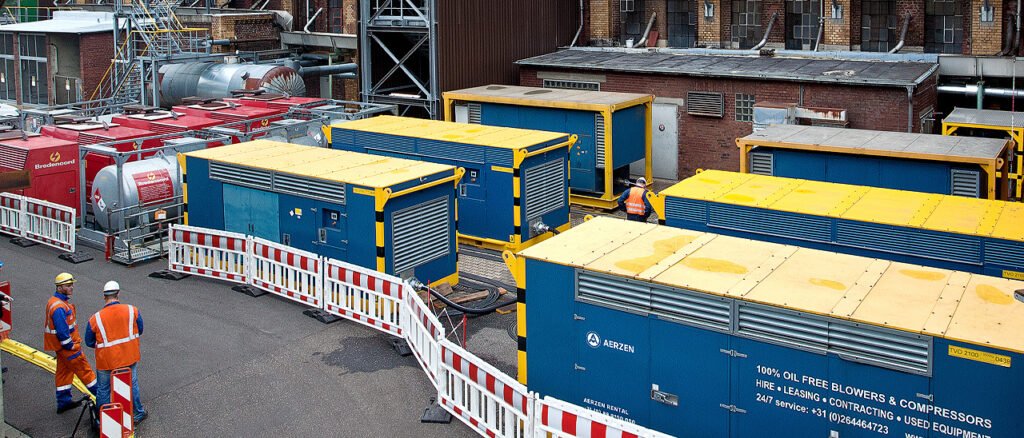
As AERZEN has designed oil-free air systems for food-safe environments since 1864, the gap between installing a certified oil-free compressor and maintaining documented, audit-ready air quality records remains one of the most common compliance vulnerabilities QA managers encounter before third-party certification audits.
This article provides a practical framework for compressed air testing frequency, sampling protocol design, and documentation structure that supports ISO 22000 Food Safety Management System certification.
Why Compressed Air is a Food Safety Hazard
ISO 22000:2018 requires organizations to identify all hazards associated with food contact surfaces, ingredients, and processing environments. Compressed air that contacts food products, packaging, or food-contact surfaces is classified as a process input and must be managed as a potential hazard source.
The three primary contamination vectors from compressed air are:
- Oil aerosol — from oil-injected compressors without downstream oil-free certification
- Particulate matter — from aged filter elements, corroded pipework, or inadequate filtration specification
- Moisture — from inadequate drying, leading to microbial growth in distribution pipework
According to the British Compressed Air Society (BCAS) and the European Hygienic Engineering & Design Group (EHEDG), food manufacturers are expected to define their compressed air purity class, document the basis for that class selection, and verify through periodic testing that the actual air quality delivered to food-contact points meets the defined standard.
The Standard Framework: ISO 8573-1 in a Food Safety Context
ISO 8573-1:2010 provides the purity class system that most food manufacturers reference within their HACCP or food safety plans. The three contaminant categories relevant to food processing are:
| ISO 8573-1 Contaminant | Class 0 Limit | Class 1 Limit | Food Contact Recommendation |
|---|---|---|---|
| Oil (aerosol + vapor) | Not detected | ≤ 0.01 mg/m³ | Class 0 for direct food contact |
| Solid particles (> 1 μm) | Per user specification (stricter than Class 1)¹ | Specified per sub-class | Class 1 or better |
| Water vapor (pressure dew point) | ≤ −70 °C | ≤ −70 °C | ≤ −40 °C acceptable for some indirect contact |
Key regulatory position: ISO 22000:2018 does not prescribe a specific ISO 8573 class. Your HACCP team must perform the hazard analysis and justify the class selection. For direct food contact applications, most third-party certification bodies (SQF, BRC, FSSC 22000) expect Class 0 or Class 1 oil content.
¹ ISO 8573-1:2010 Class 0 — limits are user-defined per § 4 (more stringent than Class 1); no numeric particle count is specified by the standard itself.
ISO 8573-1:2010 is available at: https://www.iso.org/
Sampling Protocol: Where and How to Sample
Sampling Point Selection
The sampling protocol must be designed to verify air quality at the point of use, not at the compressor outlet. This distinction is critical because:
- Filtration elements degrade between PM intervals
- Pipework corrosion adds particulate load downstream
- Distribution layout creates dead-legs where moisture accumulates
Recommended sampling points:
- Immediately downstream of the final filter bank (before distribution header)
- At the highest-risk point of use (direct product contact nozzle, packaging fill head, or CIP blow-down point)
- At the furthest point from the compressor (worst-case pressure drop + moisture accumulation)
- At any dedicated outlet serving Class 0 application areas
Sampling Method
ISO 8573-4 (particle testing), ISO 8573-5 (oil vapor testing), and ISO 8573-6 (gaseous contaminants) provide the specific sampling and measurement methods. For practical food facility audits, the most commonly referenced methods are:
- Oil aerosol + vapor: Gravimetric sampling using a collection filter, then gas chromatography — minimum sample volume per ISO 8573-5:2001
- Particulate: Optical particle counter, isokinetic sampling
- Dew point: Chilled mirror hygrometer or electronic capacitive sensor at point of use
Important: Sampling should be conducted with the compressed air system under representative production load, not during low-demand periods. Off-peak sampling underestimates contamination from entrained moisture and filter bypass.
Testing Frequency: Building a Defensible Schedule
There is no single mandated testing frequency in ISO 22000 — frequency must be determined by your hazard analysis. However, industry practice and certification body expectations generally follow this framework:
| Risk Level | Typical Frequency | Trigger for Review |
|---|---|---|
| Direct food contact (Class 0 required) | Quarterly or after filter change | Any filter maintenance event |
| Indirect food contact | Bi-annual | Change in production volume or line configuration |
| Packaging environment | Bi-annual | New supplier, new packaging format |
| Utility / purging only | Annual | No food contact demonstrated |
Change-event triggers — the following should automatically trigger an unscheduled test:
- Replacement of any downstream filter element
- Any compressor maintenance event (bearing replacement, seal change)
- Expansion of compressed air distribution pipework
- Detection of abnormal color, odor, or moisture at any outlet
- Change of lubricant type (for oil-injected machines in adjacent circuits)
Internal vs Third-Party Testing
For initial certification and annual verification, most certification bodies prefer third-party laboratory testing. For ongoing monitoring between annual tests, calibrated in-house particle counters and dew point meters are acceptable if the instruments are within calibration and maintained per the manufacturer’s schedule.
Documentation Requirements for ISO 22000 Audit Readiness
Your compressed air quality program must be documented as part of your Prerequisite Programme (PRP) under ISO 22000 Clause 8.2. Auditors will typically request:
- Compressed Air Quality Policy — defines the purity class standard, scope, and responsibility
- Hazard Analysis Record — shows the reasoning for class selection by application point
- Sampling Plan — points, frequency, method, responsible person
- Test Reports — from accredited laboratory or calibrated in-house instrument, retained for minimum 3 years (or as per certification body requirement)
- Non-conformance Log — any out-of-spec result and corrective action taken
- Filter PM Records — element change log linked to re-test events
- Compressor Service Records — as supporting evidence for contamination risk assessment
Practical audit tip: Auditors look for a closed loop. Test result → review → corrective action → re-test. Gaps in this loop — particularly missing re-test records after a non-conformance — are a frequent citation in SQF and FSSC 22000 audits.
The Role of the Air Source in Sustaining Compliance
A documented testing program is only as effective as the underlying air quality delivered by the source equipment. Facilities that rely on oil-injected compressors with downstream filtration carry a permanent audit risk: filter elements fail silently, and oil contamination events may not trigger visible alarms.
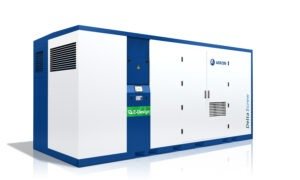
Oil-free compressors eliminate the contamination-at-source risk by design. AERZEN’s Delta Screw Blower (BVO) and Delta Screw E-Compressor (BVS) series operate with oil-free compression chambers, delivering ISO 8573-1 Class 0 air without relying on downstream filtration to achieve oil-free status. This simplifies the HACCP hazard analysis: the contamination pathway from lubricant is eliminated at the source.
For facilities undergoing initial ISO 22000 certification or responding to a corrective action from a previous audit, rental of a verified oil-free unit provides a documented, certifiable air source while the long-term procurement decision is evaluated.
Case Study (illustrative example): Food Processing Facility — FSSC 22000 Certification Preparation
Note: The following is a worked example. Data has been anonymized.
A food processing facility preparing for FSSC 22000 certification identified compressed air as an uncontrolled hazard in their initial gap assessment. Their existing oil-injected compressor had no documented oil content test results, and filter change records were incomplete for the prior two years.
The corrective action plan included:
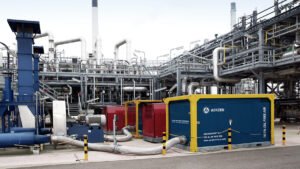
- Temporary rental of an AERZEN oil-free Screw Blower for the food-contact production line (replacing the oil-injected compressor for that circuit)
- Third-party ISO 8573-5 oil aerosol test at three point-of-use locations, with results documented as the baseline
- Implementation of a quarterly test schedule with filter change events as automatic re-test triggers
- Development of a Compressed Air PRP document linking hazard analysis → sampling plan → test records → non-conformance procedure
The facility passed FSSC 22000 certification audit within the same quarter, with zero major non-conformances related to compressed air.
Frequently Asked Questions
Q1: Does ISO 22000 require ISO 8573-1 Class 0 for all compressed air in food facilities? A: No. ISO 22000 requires hazard analysis — the purity class is determined by the application. However, for compressed air that contacts food products or food-contact surfaces directly, Class 0 (or Class 1 with documented justification) is the expectation of most third-party certification bodies including SQF, BRC Global Standards, and FSSC 22000.
Q2: Can a facility use oil-injected compressors with filtration and still pass ISO 22000 audit? A: Yes, but it requires more documentation burden. The facility must demonstrate that the filtration system is capable of achieving the required purity class, that filter elements are changed at the prescribed interval, and that post-filter testing is performed. Any filter failure event creates a documented food safety incident that must be managed through the non-conformance system.
Q3: How often should filter elements be changed in a food manufacturing environment? A: Filter manufacturer recommendations typically specify maximum time or pressure differential, whichever comes first. In food environments, the conservative approach is to change on time (typically 6–12 months depending on filter type and duty) without waiting for pressure differential to trigger the indicator, because a loaded filter close to bypass does not provide a visible warning.
Q4: What accreditation should the testing laboratory hold for results to be accepted by auditors? A: ISO/IEC 17025 accreditation for the specific test methods (ISO 8573-4, -5, -6) is the standard requirement. Verify the laboratory’s scope of accreditation covers compressed air testing before commissioning. In Thailand, accredited laboratories operating under NATA or equivalent ILAC-MRA member bodies are accepted.
Q5: If AERZEN provides a rental compressor, does it come with oil content certification documentation? A: AERZEN oil-free machines are certified at the design level. For rental units, the engineering team can provide specifications and assist the facility in establishing a testing baseline. Contact the AERZEN Rental Thailand team for documentation requirements specific to your certification body.
Q6: What happens to the HACCP plan if we switch from oil-free rental to a purchased oil-injected compressor after certification? A: This constitutes a change to a hazard control measure. Under ISO 22000 Clause 8.1, a change that affects food safety must trigger a review of the relevant section of the hazard analysis and potentially a re-validation of the PRP or HACCP control measure. Switching to oil-injected without re-analysis would be a non-conformance if identified during audit.
Request a Consultation with AERZEN Engineering Team
AERZEN Rental Thailand supports QA teams and facility engineers in selecting air supply solutions that meet ISO 22000 documentation requirements and reduce audit risk from the source.
Contact the AERZEN Rental Thailand team:
- Office: 038-015-488
- Hotline (24/7): 098-323-2626
- Email: thai@aerzenrental.com
- Website: www.aerzenrentalth.com
Rent a solution. Expect performance.
uthority Citations
- ISO 22000:2018 — Food safety management systems — Requirements for any organization in the food chain: https://www.iso.org/
- ISO 8573-1:2010 — Compressed air — Part 1: Contaminants and purity classes: https://www.iso.org/
- British Compressed Air Society (BCAS) — Compressed Air Quality in the Food and Beverage Industry (guidance document): https://www.bcas.org.uk/

✍️ เกี่ยวกับผู้เขียน
ภราดร วรรณสังข์ (Paradorn Wannasung)
Marketing Communication Specialist · นิเทศศาสตรมหาบัณฑิต (การสื่อสารการตลาดและแบรนด์)
ภราดร (Paradorn) เป็นผู้ดูแลด้านการสื่อสารการตลาดของ AERZEN Rental Thailand จบนิเทศศาสตรมหาบัณฑิต (การสื่อสารการตลาดและแบรนด์) เชี่ยวชาญด้านอุตสาหกรรม B2B ในประเทศไทย มีประสบการณ์การสร้างแบรนด์และคอนเทนต์ในกลุ่มอุตสาหกรรมของไทย
ติดต่อ: pwa@aerzenrental.com · LinkedIn