As AERZEN has refined through more than 160 years of engineering — dating to its founding in 1864 — one principle has remained constant: the blower specification follows the process, never the reverse. A blower selected without a rigorous load profile analysis will either over-consume energy at partial load or under-deliver air at peak demand. Both outcomes carry operational cost.
Why Load Profile Is the Foundation of Blower Specification
Plant engineers routinely approach blower selection by working from a single operating point: rated flow at rated pressure. In a laboratory or a steady-state chemical process, this simplification is defensible. In most real industrial processes — wastewater aeration, pneumatic conveying, chemical drying, food packaging — the demand curve is not flat.
A load profile captures:
Without all four elements, any blower specification is an estimate. With them, the engineer can match machine to process with engineering precision.
Step 1: Establish the Flow Demand Curve
Begin by logging flow demand at the application point — not at the machine outlet — over a full operating cycle. For batch processes, one complete batch constitutes a representative cycle. For continuous processes (wastewater, for example), 24 hours on a weekday and 24 hours on a weekend day typically reveal the operating envelope.
Data collection methods:
Express the result as a demand histogram: flow on the Y-axis, time fraction on the X-axis. The histogram immediately reveals the P10, P50, and P90 flow points — the flows exceeded 90%, 50%, and 10% of the time respectively.
Why P10/P50/P90 matter more than the peak:
Sizing to the P10 point (the highest flow, exceeded only 10% of the time) produces a machine that runs at extreme part-load for the majority of its operating hours. Depending on the blower type, part-load operation may carry a significant specific power penalty. The methodology that follows uses the full histogram, not the peak alone.
Step 2: Correct for Inlet Conditions
Blower manufacturers specify performance at ISO reference conditions: 1 bar(a) inlet pressure, 20°C, 0% relative humidity. Thai industrial sites routinely operate at:
Correction procedure:
For a site at 40°C and 90% RH near sea level, the correction factor on volumetric flow is typically in the range of 1.06–1.10 relative to ISO conditions — meaning the machine must displace a larger volume to deliver the same mass of air to the process. This correction, if omitted, leads to systematic undersizing.
Step 3: Calculate System Resistance
The discharge pressure at which the blower must operate is determined by the system resistance, not by an arbitrary design point. System resistance comprises:
Sum these elements to obtain the design system pressure at the blower outlet flange. Add an engineering margin of 5–10% to account for filter fouling between service intervals.
Step 4: Select Blower Type Against the Demand Histogram
With the corrected flow histogram and system pressure established, map the requirement against blower technology characteristics:
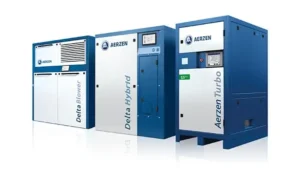
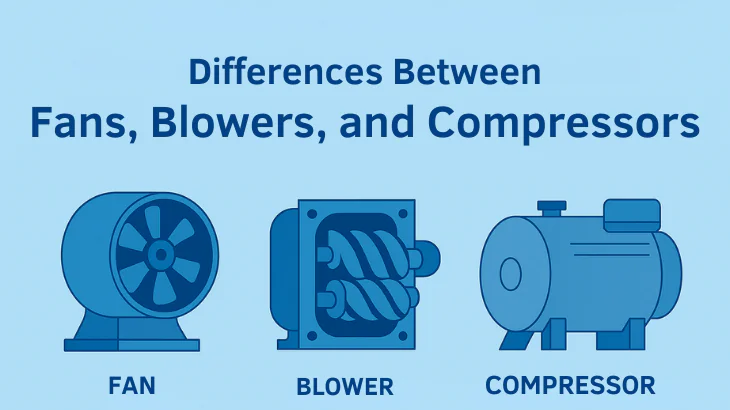
Positive Displacement (Roots/Screw) Blowers
Suitable for pressure range approximately 300–1,000 mbar (g). Flow is largely independent of discharge pressure, making them predictable for constant-pressure systems. Part-load control via inlet throttling or speed variation (VSD).
AERZEN DVO and BVO Series fall in this category. Typical applications: wastewater aeration at moderate tank depth, pneumatic conveying at low-to-medium pressure, biogas handling.
Screw Blowers / Compressors
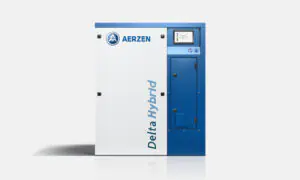
Suitable for pressure range approximately 500–2,000 mbar (g). Internal compression provides better efficiency at design pressure. AERZEN Delta Screw E-Compressor is representative. Part-load via VSD — the specific power curve is relatively flat across 50–100% load with VSD control, making this type well-suited to processes with significant flow variation.
Turbo Blowers
Suitable for large volumetric flows at low-to-medium pressure. Highly efficient at design point; efficiency falls sharply outside the surge-stall envelope. Best suited to processes with a narrow, predictable flow range.
Practical selection rule from the histogram:
If the P90-to-P10 flow ratio (max sustained flow divided by the base flow exceeded 90% of the time) is less than 1.5, a fixed-speed machine with inlet throttling may be adequate. If the ratio exceeds 1.5 — common in food production batch cycles and municipal wastewater with strong diurnal swing — a VSD machine or a staged multi-unit arrangement is preferable.
Step 5: Verify Against Performance Curves
Blower manufacturers publish performance maps — curves of flow versus discharge pressure at various speeds. Overlay your corrected operating points (P10, P50, P90) on the map to confirm:
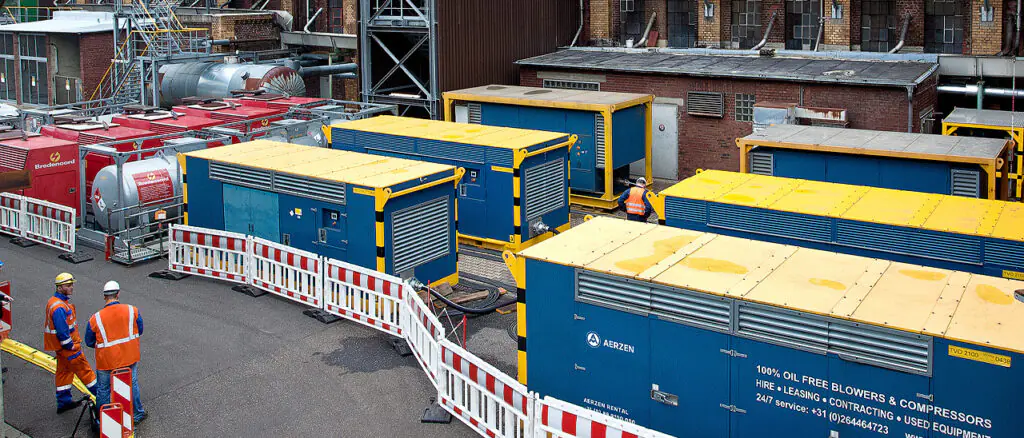
For rental applications, AERZEN Rental Thailand engineers perform this verification as part of the pre-delivery check and can provide the machine-specific performance map for the selected unit.
worked example: Case Illustration (Illustrative Data Only)
A plant engineer at a food processing facility (Eastern Thailand — worked example, anonymised) had a 4,000 Nm³/h air demand at peak production, dropping to 1,600 Nm³/h during overnight cleaning-in-place cycles. System pressure was 650 mbar (g).
Initial specification (single fixed-speed blower at 4,000 Nm³/h, 650 mbar) was reviewed against the load histogram. The P50 flow was 2,200 Nm³/h — meaning the machine would run at approximately 55% of rated flow for half its operating hours. For a Roots-type blower without VSD, this results in notable specific power elevation at part-load.
The revised specification used two AERZEN DVO units: one sized for base load (1,800 Nm³/h, VSD), one for peak topping-up (2,400 Nm³/h, fixed-speed). The base-load unit runs continuously at variable speed; the peak unit starts only during production hours. The load-profile-based sizing produced a more energy-efficient operating arrangement across the full daily cycle.
> Note: This is a figures are illustrative for methodology demonstration. Contact AERZEN Rental Thailand for site-specific assessment.
Documentation the Engineer Should Retain
After completing the sizing exercise, document the following for future reference and for any rental/procurement scope of work:
This documentation supports the rental specification, forms the basis for a performance guarantee clause, and serves as the baseline for future capacity reviews.
Frequently Asked Questions
Q1: Can I perform this sizing analysis using only the blower manufacturer’s published data sheets? A: Data sheets provide the performance map but not the inlet correction procedure or system resistance calculation. The full methodology requires both. AERZEN technical engineers can assist with the system resistance calculation if site measurements are provided.
Q2: How does elevation above sea level affect blower selection in Thailand? A: Most EEC and central Thailand sites are near sea level and the correction is modest. Sites above 300 m ASL — particularly in the north — experience meaningfully lower inlet density. The volumetric correction for a 500 m ASL site at 38°C relative to ISO reference conditions can approach 15%, requiring a machine with a larger swept volume to deliver the same mass flow.
Q3: Is a VSD blower always more efficient than a fixed-speed machine? A: Not at constant load. A VSD drive introduces its own electrical losses (typically 2–4%) compared with direct-on-line starting. For processes that run continuously at or near design flow, a fixed-speed machine may produce a lower overall specific power. The load histogram is the deciding input.
Q4: What performance data does AERZEN Rental Thailand provide with a rental unit? A: Each unit comes with the factory test certificate and the machine-specific performance map. For projects requiring documented performance evidence (e.g., ISO 8573-1 compliance), AERZEN can arrange on-site air quality sampling in coordination with accredited testing laboratories.
Q5: How often should the load profile be re-evaluated? A: Any significant change in process throughput, product mix, diffuser replacement, or system piping modification warrants a re-evaluation. As a routine practice, an annual review of the demand histogram against actual meter readings is reasonable.
Request a Technical Assessment
If you are preparing a blower specification or reviewing an existing installation, AERZEN Rental Thailand’s engineering team can review your load profile data and confirm the appropriate machine selection.
AERZEN Rental Thailand
*Rent a solution. Expect performance.*
References
[1] ISO 8573-1:2010 — Compressed Air — Part 1: Contaminants and purity classes. International Organization for Standardization. https://www.iso.org/
[2] AERZEN Group — Product Portfolio: Blowers, Compressors and Vacuum Pumps. Aerzener Maschinenfabrik GmbH. https://www.aerzen.com/products.html
[3] Compressed Air and Gas Institute (CAGI) — Engineering Data Book and Technical Resources. https://www.cagi.org/ (Note: specific author attribution removed — citation updated to main CAGI resource page per R1 editorial review; consult CAGI directly for current edition reference.)
Hashtags
#AERZENRental #BlowerSizing #OilFreeAir #PlantEngineering #ISO8573 #CompressedAir #IndustrialEngineering

✍️ เกี่ยวกับผู้เขียน
ภราดร วรรณสังข์ (Paradorn Wannasung)
Marketing Communication Specialist · นิเทศศาสตรมหาบัณฑิต (การสื่อสารการตลาดและแบรนด์)
ภราดร (Paradorn) เป็นผู้ดูแลด้านการสื่อสารการตลาดของ AERZEN Rental Thailand จบนิเทศศาสตรมหาบัณฑิต (การสื่อสารการตลาดและแบรนด์) เชี่ยวชาญด้านอุตสาหกรรม B2B ในประเทศไทย มีประสบการณ์การสร้างแบรนด์และคอนเทนต์ในกลุ่มอุตสาหกรรมของไทย
ติดต่อ: pwa@aerzenrental.com · LinkedIn