
As AERZEN has understood since 1864, reliable compressed air is not a product you buy once — it is a performance you sustain. The discipline that keeps that performance consistent is maintenance. Yet for most maintenance managers overseeing industrial blower and compressor systems, the question is not whether to maintain but how — and specifically, when the classical preventive approach is sufficient and when predictive methods justify the investment.
This article provides a structured framework for answering that question, grounded in engineering principles and practical considerations for compressed air systems in Southeast Asian industrial environments.
Defining the Two Approaches
Preventive Maintenance (PM)
Preventive maintenance operates on a time-based or usage-based schedule independent of the actual condition of the equipment. Filters are changed every 2,000 hours. Belts are inspected at six-month intervals. Lubricant is replaced according to manufacturer specification, not measured degradation.
The logic is straightforward: known wear mechanisms occur at predictable rates under defined operating conditions. By intervening before failure is likely, plant reliability is maintained without requiring continuous monitoring infrastructure.
ISO 9001:2015 quality management systems typically incorporate preventive maintenance as a standard element of production equipment management. The standard requires that organisations “determine, provide and maintain the infrastructure necessary for the operation of its processes” — maintenance schedules are the operational expression of that requirement. Reference: ISO 9001:2015
Predictive Maintenance (PdM)
Predictive maintenance uses real-time or periodic condition data to infer the actual state of a component and intervene only when condition indicators suggest impending degradation or failure.
Common measurement vectors in compressed air systems include:
- Vibration analysis — detects bearing wear, rotor imbalance, misalignment
- Thermal imaging (thermography) — identifies heat anomalies in motors, drives, and connections
- Oil particle counting — in oil-flooded machines, monitors lubricant degradation rate
- Acoustic emission — detects developing cracks or leaks at ultrasonic frequencies
- Pressure differential monitoring — tracks filter loading and valve condition
The Institute of Electrical and Electronics Engineers (IEEE) has published extensive guidance on condition monitoring standards; the ASHRAE Handbook — HVAC Applications similarly addresses predictive maintenance frameworks applicable to rotating machinery. Reference: ASHRAE HVAC Applications Handbook
The Core Trade-off
Neither approach is unconditionally superior. Each carries a different profile of cost, capability requirement, and risk.
| Dimension | Preventive Maintenance | Predictive Maintenance |
|---|---|---|
| Trigger | Schedule / usage threshold | Condition indicator |
| Data infrastructure | Minimal | Sensors + analytics platform |
| Specialist skill | Technician-level | Reliability engineer or PdM analyst |
| Risk of over-maintenance | Higher | Lower |
| Risk of unexpected failure | Low–moderate | Low, if sensors calibrated |
| Effectiveness on wear-out failures | High | High |
| Effectiveness on random failures | Limited | Limited |
| Implementation lead time | Immediate | Weeks to months |
The category “random failures” — such as a manufacturing defect in a component or a one-off surge event — is not addressed well by either approach. This is where equipment design quality and the robustness of AERZEN’s engineering heritage matter: machines designed with rigorous tolerances and validated by TÜV Rheinland certification produce fewer random failure events.
When Preventive Maintenance Is the Right Choice
Preventive maintenance is the appropriate primary strategy when:
1. The failure mode is age-related or usage-related. Filter media loading, seal degradation, and belt wear all follow reasonably predictable curves. Time-based replacement is cost-effective because the replacement interval can be set conservatively without wasting significant component life.
2. The cost of monitoring infrastructure exceeds the expected benefit. On smaller machines or short rental contracts, installing a vibration monitoring system and training analysts may not be warranted. For a Subscription Plan rental of 3–6 months, AERZEN’s built-in service intervals already cover PM requirements.
3. The operating environment is stable. In a controlled environment where inlet conditions, load, and ambient temperature are consistent, manufacturer-specified PM intervals apply with high confidence.
4. Regulatory compliance requires documented schedules. In pharmaceutical manufacturing — where FDA 21 CFR Part 211 or EU GMP Annex 1 governs utility equipment maintenance — a documented, validated PM schedule is often a regulatory requirement independent of the actual condition of the equipment.
When Predictive Maintenance Adds Clear Value
Predictive maintenance justifies its additional infrastructure cost when:
1. Unexpected downtime carries a disproportionately high consequence. In continuous-process industries — petrochemical, semiconductor fabrication, or sterile pharmaceutical fill-finish — an unplanned compressor failure can trigger a cascade: process interruption, product loss, line re-qualification. In these environments, the cost of a monitoring sensor is trivial relative to one prevented shutdown event.
2. The machine runs continuously at high load. A compressor operating at 90–100% capacity 24/7 accumulates stress much faster than the same machine on a standard duty cycle. Condition-based maintenance catches accelerated wear that a calendar-based schedule would miss.
3. Bearing and rotor condition must be known between scheduled intervals. Vibration signatures change weeks before a bearing enters a failure zone. This lead time is PdM’s core value proposition: it converts a potential emergency into a planned replacement.
4. The asset base is large enough to justify a centralised monitoring platform. Plants with five or more critical rotating machines benefit from a unified condition monitoring dashboard where trend data across assets is compared and prioritised.
The Hybrid Approach — Practical Engineering
Most well-managed compressed air systems in practice use a hybrid model: a PM baseline for high-confidence wear items (filters, oil, seals, belts) combined with PdM monitoring on the components where early detection has the highest consequence value (bearings, rotor clearances, motor windings).
The IFM Electronic application guide on condition monitoring for compressors outlines a practical sensor placement strategy: accelerometers on drive-end and non-drive-end bearings, temperature sensors on discharge headers, and current monitors on motor drives. Reference: IFM Electronic condition monitoring resources
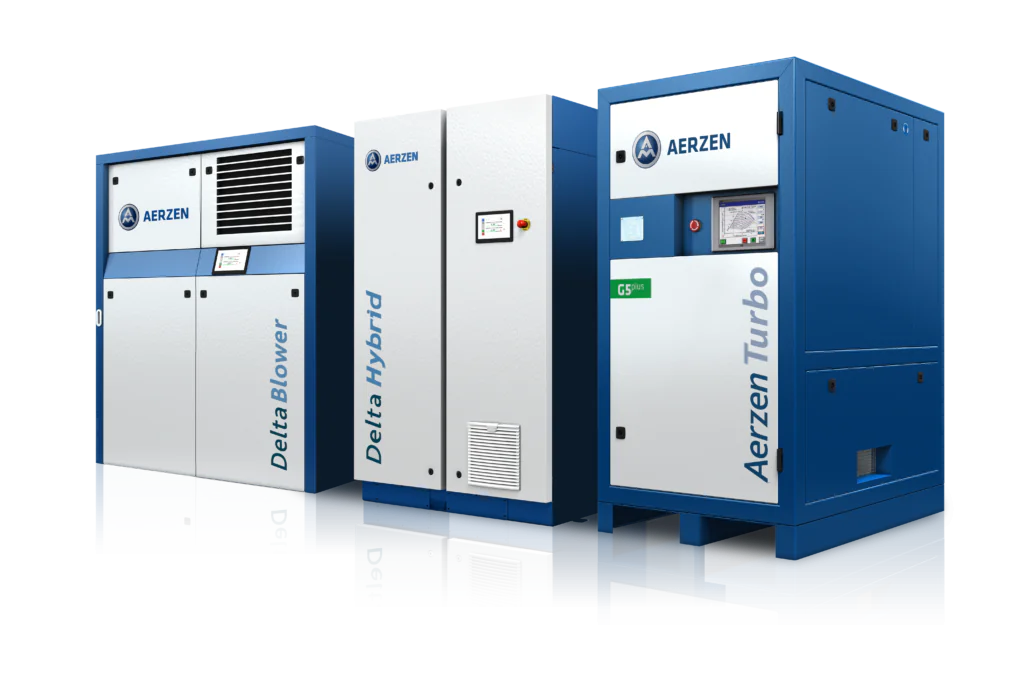
AERZEN’s own diagnostic tools — available through the AERZEN Performance3 and Delta Hybrid series — incorporate embedded condition monitoring that feeds into service workflows, effectively delivering the hybrid model as part of the standard machine package rather than requiring a separate installation.
Application to Oil-Free Compressed Air Systems
The maintenance logic for oil-free machines differs from oil-flooded machines in one important respect: oil analysis is removed from the PM scope, but air quality verification — confirming ISO 8573-1 Class 0 compliance — should be maintained as a periodic check, particularly in pharmaceutical and food applications where the consequence of contamination is regulatory.
For oil-free rotary screw machines in the AERZEN range:
- Intake filters remain a high-priority PM item — contaminated inlet air degrades rotor clearances over time
- Bearings are candidates for vibration-based PdM given the continuous load profiles typical in process applications
- Cooling system (intercooler, aftercooler, radiator) should be inspected on a PM schedule; fouling is gradual but predictable
- Seals and gaskets are time-based PM items; the replacement interval is specified per model
Case Study — Process Plant, EEC Zone (worked example — simulated data for educational purposes)
Note: The following is a worked example. It does not represent data from a specific named customer.
A specialty chemicals plant in the Eastern Economic Corridor operated three oil-free rotary screw blowers on a fixed PM schedule: all PM tasks performed quarterly regardless of condition.
After a reliability review, the team restructured the approach:
- Intake filters: retained on PM schedule (consistent environment, well-understood loading rate)
- Drive bearings: added continuous vibration monitoring with threshold alerts
- Cooling circuit: retained PM but shifted from quarterly to condition-based inspection using thermal imaging twice a year
Within twelve months of implementation, the vibration monitoring system provided early warning of bearing wear on one unit approximately six weeks before the projected calendar-based replacement date. The bearing was replaced during a planned weekend shutdown rather than as an emergency intervention. Production continuity was maintained; the unscheduled downtime scenario was prevented.
FAQ
Q1: Does switching to predictive maintenance mean eliminating the PM schedule entirely? A: In practice, no. Predictive maintenance supplements rather than replaces preventive maintenance for most compressed air applications. Wear items such as filters and seals remain well-suited to time-based replacement; PdM adds value specifically on components where condition can be measured and the failure mode has an observable lead indicator.
Q2: What is the minimum sensor set for a useful PdM programme on a single compressor? A: A practical minimum is one accelerometer per bearing housing (typically two bearing positions per machine) plus a discharge temperature sensor. This set detects the majority of mechanical wear events and thermal anomalies. Adding a pressure differential sensor across the inlet filter extends coverage to the intake system.
Q3: How do AERZEN Subscription Plan customers handle maintenance? A: Under AERZEN’s all-inclusive Subscription Plan, maintenance scheduling is managed by AERZEN’s service team. Customers benefit from AERZEN’s maintenance expertise and receive machines maintained to factory specification throughout the contract term without carrying maintenance burden internally.
Q4: Are there ISO standards for predictive maintenance? A: ISO 13373 series covers condition monitoring and diagnostics of rotating machinery. ISO 17359:2018 provides general guidance for condition monitoring of machines. Reference: ISO 13373-1, ISO 17359:2018
Q5: How does ambient temperature in Thailand affect PM interval planning? A: Thailand’s high ambient temperature (typically 30–38°C in industrial zones) accelerates lubricant oxidation in oil-lubricated machines and increases thermal load on cooling systems. For oil-free machines, the principal effect is on cooling system fouling rates — which in humid coastal environments may require more frequent inspection than northern-European manufacturer baselines suggest. Adjusting PM intervals to local conditions is a standard recommendation by AERZEN service engineers.
References
- ISO 9001:2015 — Quality management systems — Requirements — ISO Standard
- ISO 13373-1:2002 — Condition monitoring and diagnostics of machines — ISO Standard
- ISO 17359:2018 — Condition monitoring and diagnostics of machines — General guidelines — ISO Standard
- ASHRAE Handbook — HVAC Applications (rotating machinery section) — ashrae.org
- IFM Electronic — Condition monitoring application resources — ifm.com
Request Engineering Consultation
AERZEN Rental Thailand’s technical team can review your current maintenance strategy against your operating profile and recommend whether preventive, predictive, or a hybrid approach is appropriate for your compressed air system configuration.
- Office: 038-015-488
- 24/7 Hotline: 098-323-2626
- Email: thai@aerzenrental.com
- Website: www.aerzenrentalth.com
Rent a solution. Expect performance.

✍️ เกี่ยวกับผู้เขียน
ภราดร วรรณสังข์ (Paradorn Wannasung)
Marketing Communication Specialist · นิเทศศาสตรมหาบัณฑิต (การสื่อสารการตลาดและแบรนด์)
ภราดร (Paradorn) เป็นผู้ดูแลด้านการสื่อสารการตลาดของ AERZEN Rental Thailand จบนิเทศศาสตรมหาบัณฑิต (การสื่อสารการตลาดและแบรนด์) เชี่ยวชาญด้านอุตสาหกรรม B2B ในประเทศไทย มีประสบการณ์การสร้างแบรนด์และคอนเทนต์ในกลุ่มอุตสาหกรรมของไทย
ติดต่อ: pwa@aerzenrental.com · LinkedIn
บทความที่เกี่ยวข้อง
Maintenance — Predictive Maintenance ด้วย AERprogress | AERZEN Knowledge Base
AERprogress predicti...
อ่านต่อ →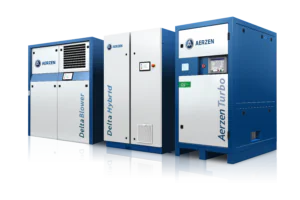
Return Inspection ของเครื่องเช่า: เกณฑ์ตรวจสภาพที่ฝ่ายจัดซื้อควรกำหนด
ตามที่ AERZEN สะสมปร...
อ่านต่อ →